
Screenless Fitness Tracker vs. Smartwatch: Which One Is Right for Your Customers?
Introduction: Why This Choice Matters to Your Business
The wearable technology market continues to offer consumers more choices, from traditional smartwatches to screenless fitness trackers, smart bracelets, and health monitoring devices. For wearable brands, importers, wholesalers, and distributors, choosing the right product category is an important decision that can influence product positioning, customer satisfaction, and long-term business growth.
A common question among buyers is whether a screenless fitness tracker can compete with a traditional smartwatch. Both products support fitness-related functions, but they offer different wearing experiences and serve different customer needs.
Smartwatches generally focus on display interaction, notifications, and multifunctional applications. Screenless fitness trackers focus more on health monitoring, daily activity tracking, and simplified wearable experiences.
This guide explains the differences between these products, highlights the key factors buyers should consider when selecting a supplier, and introduces the M50 Smart Bracelet as a potential addition to your wearable product portfolio.
Whether you are developing a new product line or expanding an existing collection, understanding these differences can help you make more informed purchasing decisions.
Section 1: Key Concepts Every Buyer Should Understand
What Is a Screenless Fitness Tracker?
A screenless fitness tracker, also known as a smart bracelet, smart band, or display-less fitness band, is a wearable device designed to monitor daily activities and health-related information without a traditional display.
Unlike conventional smartwatches, screenless devices generally synchronize collected information with a companion smartphone application. Users can check their health data, exercise records, and sleep information through their phones.
Depending on the model, an activity tracker may support several functions, including:
· Heart rate monitoring.
· Blood oxygen monitoring.
· Sleep tracking.
· Step counting.
· Multiple exercise modes.
· Heart rate variability (HRV).
· Stress-related monitoring.
· Smartphone notifications.
The main advantage of this product category is its focus on essential wearable functions without requiring users to interact with a screen throughout the day.
For manufacturers and distributors, screenless fitness bands offer another product option for customers who prefer a simpler wearable device.
Screenless Fitness Tracker vs. Smartwatch: What Are the Main Differences?
Although both products belong to the wearable technology market, their positioning and user experiences are different.
Comparison | Screenless Fitness Tracker | Smartwatch |
Display | No traditional display | Built-in display |
Interaction | Smartphone application | Watch and smartphone |
Main focus | Health and fitness tracking | Smart functions and fitness |
Data viewing | Mobile application | Watch screen and application |
Design | Minimalist and discreet | Traditional watch-style design |
Daily use | Health and activity monitoring | Notifications and multiple functions |
Target customers | Health-conscious and fitness-oriented users | Customers seeking broader smart features |
Which product is right for your customers?
There is no universal winner. The right choice depends on customer expectations and market positioning.
A smartwatch may be more suitable for consumers who want to read messages, interact with applications, and access information directly from their wrists.
A screenless fitness tracker may appeal to customers who prioritize daily activity tracking, health monitoring, and a less complicated wearing experience.
For wholesalers and distributors, offering both categories can help create a more complete wearable product portfolio and reach different customer segments.
What Health Monitoring Functions Should Buyers Look For?
Health monitoring is an important consideration when consumers choose a modern fitness band or smart bracelet.
Basic step counting is no longer the only feature customers consider. Many users also want access to information about heart rate, blood oxygen, sleep, and daily activity.
Here are several functions worth evaluating:
1. Heart Rate Monitor
A heart rate monitor tracks heart rate information during daily activities and exercise. It is one of the most common features in the smart bracelet and fitness tracker market.
2. Blood Oxygen Monitor
A Blood Oxygen Monitor provides blood oxygen-related readings through the device's sensor system. It adds another type of wellness information for users interested in monitoring their daily health data.
3. Sleep Tracker
A sleep tracker records sleep-related information and allows users to review their sleep patterns through a companion application.
4. HRV and Stress Monitoring
Heart rate variability and stress-related monitoring provide additional wellness information. These functions can make a health tracker more attractive to consumers interested in understanding their daily activity and recovery patterns.
5. Sports and Activity Tracking
A sports tracker supports exercise-related functions, while an activity tracker focuses on daily movement, including steps and other activity records.
For buyers, it is important to check which functions are genuinely supported by the product rather than relying on general descriptions. Sensor configuration, application performance, and actual testing results should all be considered.
Health monitoring functions should also be marketed responsibly and should not be presented as medical diagnostic capabilities without appropriate validation and regulatory documentation.
Why Battery Life and APP Compatibility Matter
Battery performance has a direct influence on the daily user experience.
Consumers who wear a smart band throughout the day may prefer a device that does not require frequent charging. For distributors, battery performance can also influence customer satisfaction and after-sales service requirements.
Connectivity is equally important. A fitness tracker should provide stable Bluetooth communication and reliable synchronization with its companion application.
Before purchasing, buyers should evaluate:
· Battery capacity and charging time.
· Actual operating time under defined conditions.
· Bluetooth version.
· Android and iOS compatibility.
· Application stability and language support.
These factors help determine whether a product can provide a satisfactory experience in its target market.
Section 2: How to Compare Smart Bracelet Suppliers — Criteria, Risk Points & Checklist
Selecting a suitable product is only one part of the purchasing process. Finding a reliable supplier is equally important.
Whether you are sourcing a smart bracelet, activity tracker, or sports tracker, you should evaluate the following factors before placing a bulk order.
Checkpoint | What to Verify | Potential Red Flag |
Health monitoring | Heart rate, SpO2, HRV and sleep functions | Unsupported health claims |
Sensor configuration | Actual sensor models and capabilities | Missing technical details |
Battery performance | Capacity, charging time and operating time | Unverified battery claims |
Connectivity | Bluetooth and smartphone compatibility | Unstable connections |
Waterproof rating | Actual rating and test conditions | Unsupported swimming claims |
APP experience | Data synchronization and language support | Poor application experience |
Product quality | Inspection and testing procedures | No clear QC process |
Branding flexibility | Logo, packaging and customization options | Unclear customization terms |
Health data accuracy
A supplier should explain which health monitoring functions are supported and provide relevant technical information. For example, if a product advertises heart rate and blood oxygen monitoring, buyers should ask about the sensors and test procedures.
Battery performance
Do not evaluate a battery only by its capacity. Ask about actual operating time, standby time, charging conditions, and the settings used during testing.
Product compatibility
Check whether the companion application supports the operating systems and languages required by your target market.
Quality control
A professional supplier should be able to explain its inspection procedures, functional testing, and pre-shipment quality checks.
OEM/ODM requirements
If you plan to develop your own brand, discuss logo printing, packaging, colors, product configuration, and customization possibilities before production.
A reliable supplier should provide clear specifications, realistic product descriptions, and verifiable information. Avoid choosing a product based only on a low quotation or attractive marketing claims.
Section 3: From Sampling to Bulk Order — How It Usually Works
Understanding the purchasing process helps wearable brands and distributors reduce sourcing risks.
1. Sampling
Request product samples before committing to a bulk order.
Samples allow you to evaluate:
· Product appearance and wearing comfort.
· Heart rate and blood oxygen monitoring.
· Sleep and activity tracking.
· Bluetooth connection stability.
· Companion application performance.
· Charging and battery functions.
· Notification and reminder features.
Testing samples is especially important when introducing a new smart band to your market.
2. Customization & OEM/ODM
For private-label projects, discuss branding and customization requirements with your supplier.
Potential options include:
· Company logo and product branding.
· Product colors.
· Strap configuration.
· Packaging design.
· Application and language requirements.
For the M50, the standard listed colors are black, gray, and blue. Strap materials, packaging specifications, and the available customization options should be confirmed separately.
3. Bulk Production
Before starting mass production, confirm the commercial terms, including MOQ, unit pricing, production lead time, payment terms, and approved product specifications.
It is important to ensure that the bulk production version matches the sample and agreed technical requirements.
4. Quality Control & Delivery
Before shipment, confirm that the supplier performs appropriate inspections of product appearance, charging, Bluetooth connectivity, sensor functions, application synchronization, and accessories.
Ask whether inspection is conducted in-house, through third-party services, or by pre-shipment inspection.
Note: MOQ, pricing, production lead time, and customization options depend on order quantity and project requirements. Exact terms should be confirmed with the supplier.
Section 4: Introducing the M50 Smart Bracelet
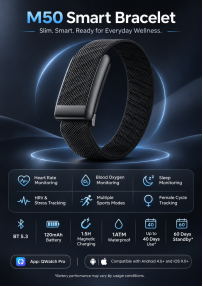
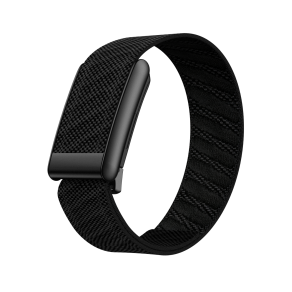
The M50 Smart Bracelet is a screenless wearable device designed around daily health monitoring, activity tracking, and smartphone connectivity.
For brands and distributors looking to expand beyond traditional smartwatches, the M50 provides an additional product option combining multiple health-related functions and convenient daily features.
1. Comprehensive Health Monitoring
The M50 supports several health-related functions, including:
· Heart rate detection.
· Blood oxygen detection.
· Pressure detection.
· Heart rate variability (HRV).
· Female physiological cycle tracking.
· Sleep monitoring.
With heart rate and blood oxygen detection, the M50 can serve customers looking for a smart bracelet with more than basic activity tracking.
Its sleep monitoring and HRV functions also provide additional wellness information through the QWatch Pro application.
For wearable brands, these functions offer opportunities to position the M50 within the health tracker and fitness band categories.
2. Multiple Exercise Modes and Activity Tracking
The M50 supports multiple exercise modes and step counting, making it suitable for everyday fitness and activity management.
Users can review exercise-related information through the QWatch Pro application.
The APP specification also lists GPS exercise functionality. However, the hardware specification identifies GPS as N/A. Buyers should therefore confirm whether GPS exercise relies on a connected smartphone before promoting route-tracking capabilities.
3. Smart Notifications and Daily Convenience
A screenless design does not mean users have to give up all smart functions.
Through QWatch Pro, the M50 supports:
· Call reminders.
· Message notifications.
· Intelligent reminders.
· Do Not Disturb mode.
· Find device.
· Low battery reminders.
· Shake to take photos.
· Device restart and factory reset.
The specification also lists motor vibration for notifications.
These functions make the M50 more than a basic step counter, while maintaining a product experience centered on smartphone connectivity.
4. 120mAh Battery and Magnetic Charging
Battery performance is an important consideration for customers who wear their devices regularly.
The M50 is equipped with a 120mAh lithium-polymer battery and supports magnetic charging.
According to its specification:
· Battery capacity: 120mAh.
· Charging method: Magnetic charging.
· Charging time: Approximately 1.5 hours.
· Listed usage time: 40 days.
· Listed standby time: 60 days.
Actual battery performance should be verified under defined operating conditions, including monitoring frequency and notification settings.
5. Bluetooth 5.3 and International Language Support
The M50 uses the Realtek 8762ESF chipset and Bluetooth 5.3 connectivity.
It works with the QWatch Pro application and supports Android 4.0 or higher and iOS 9.0 or higher.
Its listed product languages include:
· Chinese and English.
· German and Russian.
· Spanish and Portuguese.
· French and Arabic.
· Italian, Thai, and Vietnamese.
This language coverage provides a useful starting point for brands serving international customers, including several European markets.
6. Practical Design and Color Options
The M50 is available in three standard colors: black, gray, and blue.
Its dimensions are 34.5 × 23.8 × 10.9 mm, excluding the strap, and its listed weight is 43g, also excluding the strap.
The product has a 1ATM water-resistance rating. Buyers should evaluate the actual water-resistance requirements of their target market and avoid presenting this rating as swimming-grade waterproof performance.
M50 Technical Specifications at a Glance
Specification | M50 Details |
Product Type | Smart Bracelet |
Chipset | Realtek 8762ESF |
Bluetooth | 5.3 |
APP | QWatch Pro |
Heart Rate Sensor | VS30FS |
G-Sensor | STK8321 |
Battery Capacity | 120mAh |
Charging Method | Magnetic |
Charging Time | 1.5 Hours |
Listed Usage Time | 40 Days |
Listed Standby Time | 60 Days |
Waterproof Rating | 1ATM |
Compatibility | Android 4.0+ / iOS 9.0+ |
Colors | Black, Gray, Blue |
Built for Your Brand
The M50 offers an additional option for wearable brands, importers, wholesalers, and distributors who want to expand their smart bracelet and fitness tracker collections.
If you are considering the M50 for your product line, our team can discuss your target market, estimated order quantity, preferred colors, branding requirements, and customization possibilities.
We can review your project and confirm the available configurations and commercial terms before sampling and production.
FAQ (Buyer Quick Reference)
Q: What is the difference between a screenless fitness tracker and a smartwatch?
A screenless fitness tracker focuses on health and activity monitoring without a traditional display. A smartwatch generally provides a screen and more on-device interaction.
Q: Is a smart bracelet the same as a fitness band?
These terms are often used for similar wearable categories. Both can refer to devices supporting health monitoring, step counting, and smartphone connectivity.
Q: Does the M50 support heart rate and blood oxygen monitoring?
Yes. The M50 supports heart rate detection and blood oxygen detection through its monitoring functions.
Q: Can the M50 be used as a sleep tracker?
Yes. Sleep monitoring is included in the M50 specification and is available through the QWatch Pro application.
Q: How long does the M50 battery last?
The specification lists 40 days of usage and 60 days of standby. Actual performance depends on operating conditions and usage settings.
Q: What application does the M50 use?
The M50 uses QWatch Pro and supports Android 4.0 or higher and iOS 9.0 or higher.
Q: Can I customize the M50 with my own brand?
Please contact our team to confirm available OEM/ODM options, branding possibilities, and packaging requirements.
Let's Discuss Your Project
Looking for a reliable screenless fitness tracker or smart bracelet for your business?
Please share the following information:
· Target market: Your target country or region.
· Order quantity: Your estimated purchasing quantity.
· Product preferences: Preferred colors and strap requirements.
· Customization: Logo, packaging, and other requirements.
· Technical requirements: Any additional specifications you need.
Our team will review your requirements and provide relevant product specifications, available certifications, and a tailored quotation.
Shenzhen Morrison Technology Co., Ltd.
Website: www.szmorrison.com
Email: sales08@szmorrison.com
WhatsApp: +86 18923794898
Shenzhen Morrison Technology Co., Ltd. — Smart Wearable, Better Health.

Quick Links
Contact us
Categories