
A Recorder on the Wrist: How to Specify an AI Meeting-Summary Band for Bulk Orders in 2026
Introduction: Why This Question Matters to You
The brief has changed. A growing number of buyers no longer ask for a band that counts steps; they ask for a band that records a meeting, turns the audio into text, and hands back a summary the wearer can read on the phone five minutes after the room empties. That single requirement moves the product from the fitness shelf into the productivity shelf, where the buyer is an office worker, a sales team, a training department or a student, and where the purchase decision is made on whether the thing actually works in a real meeting room rather than on how the case looks.
It is also a requirement that exposes suppliers quickly. Recording is not one feature but a chain: microphone pickup, a trigger the wearer can reach without unlocking a phone, transcription latency, language coverage, a summary that extracts decisions rather than transcribing every "um", and enough storage and battery to cover a two-hour session. Add the health sensing that a wrist device is expected to carry and the whole stack has to share one small case, one cell and one radio without either function starving the other. The B20 Note is built around that compromise: a Jieli 7074A7-128M platform, an HX3918 optical sensor, BLE 5.4, a 200 mAh cell rated for up to 30 days of use, 24 g on the wrist, and a 100-language transcription and translation engine inside the Da halo app.
This guide is written for the buyer who has to sign off the specification. It explains what each block of a recorder-band specification actually delivers in daily use, how to compare two suppliers who both claim "AI meeting summary", where the hidden costs sit, and how a sample becomes a repeat order. The B20 Note is used as the worked example throughout, including the numbers you should insist on seeing before you approve packaging artwork.
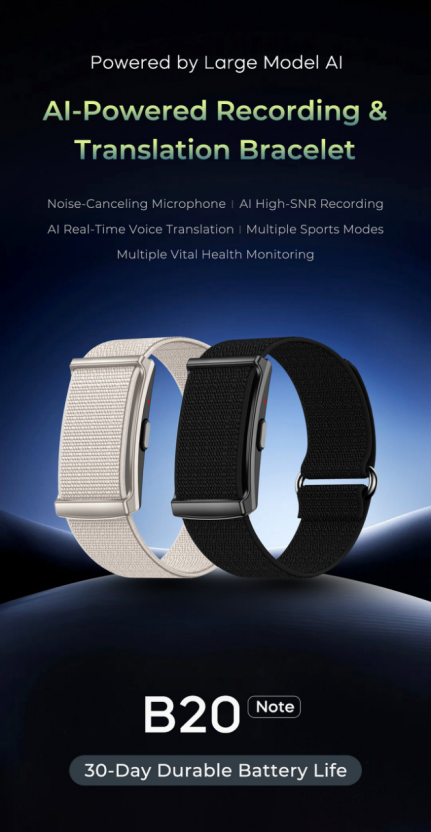
The B20 Note in its two standard finishes: woven strap, alloy-and-PC case, and a single physical key on the side for recording.
Section 1: Key Concepts Every Buyer Should Understand
1. Why a recorder bracelet is not just a fitness band with a microphone
A fitness band is designed around passive sensing: the device samples the wearer and reports numbers nobody has to operate. A recorder is an active instrument, and the design consequences are different in three places. First, the trigger: a recorder that can only be started from inside a phone app is useless in a meeting, because the wearer has to pick up the phone, unlock it, open the app and find the button while the conversation is already running. A physical key solves this in one press and is the single most important hardware decision in the category. Second, power: continuous recording draws far more current than interval heart-rate sampling, so the cell and the recording cap have to be specified together rather than separately. Third, storage and review: there is no display, so every recording has to reach the phone before it can be read, which makes the sync path and the file list part of the product rather than an afterthought.
That is also why the format is attractive commercially. Without a display, the case stays thin, the bill of materials stays controlled, and the product can carry a woven strap and a metal frame instead of a plastic slab. The B20 Note measures 8 mm at the body and weighs 24 g including the strap, which is light enough to be worn through a full working day and through the night, and that matters for the second half of this article.
2. The four-step chain: capture, transcribe, summarise, segment
Every claim about "AI minutes" should be tested against four separate steps, because suppliers are usually strong in one and weak in the next.
Capture is the microphone and the acoustic design. A band sits on the wrist, which is the worst possible place for a microphone: it is off-axis from the speakers, it moves, and it is often below the table. The practical answer is a balanced pickup pattern plus a noise-cancelling microphone, so the recording holds up when the wearer rests a hand on the table or types. Ask for the continuous recording time as well, because a device that records for 20 minutes is a note-taker, not a meeting recorder. The B20 Note is specified at 100 minutes or more of continuous recording with 360-degree balanced pickup.
Transcription is where the audio becomes text. Two entry points matter: streaming transcription on the live recording screen, which lets the wearer watch the words appear while the meeting is still running, and batch transcription on a stored audio file, which is what happens when a recording was started from the key and only reaches the phone later. A supplier that only offers the second path has effectively hidden the function behind a sync.
Summarisation is the step buyers actually pay for. A template-based one-click summary that extracts the theme and the key points of a meeting or an interview is worth more than a raw transcript, because the reader wants decisions and owners, not every sentence that was said. The question to ask is whether the summary runs on the full recording or on a truncated portion, and whether the template can be chosen by the user.
Segmentation is the difference between a usable record and a wall of text. A speaker-segmented summary splits the transcript by who was talking, so a 60-minute meeting with five participants becomes five blocks that can be assigned, circulated or filed, and the full transcript remains available behind a toggle. For training sessions and lectures, this is the step that turns a recording into study material.
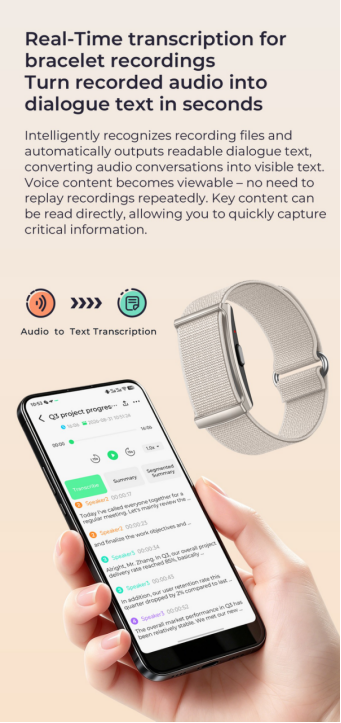
The transcription screen: live Transcribe, one-click Summary and Segmented Summary sit in the same view, with the speaker labels carried into the transcript.
3. IP68 Waterproof: what the seal protects when a microphone is inside
Water resistance stops being a hygiene feature as soon as a microphone and a speaker cavity exist, because every opening is a path for water. An IP68 rating therefore has to be designed at the case level, not added as a coating: a sealed acoustic membrane over the microphone port, a case that is bonded rather than snapped, and a charging path that does not open a door in the side of the product. That is why recorder bands generally charge magnetically instead of through a port.
For a buyer, the rating has two practical consequences. It sets the use case the product can be marketed for: hand-washing, rain, sweat and a shower are all normal wrist conditions, and a band that fails there generates returns that no margin survives. It also sets the test you should demand: not a marketing phrase, but a written statement of the rating plus the test method used on the production lot, because sealing degrades with assembly consistency long before it degrades with design.
One caution that applies to every wrist device: a water rating is a laboratory statement, not a lifetime guarantee. Seals age, adhesives creep, and a case that has been dropped onto a hard floor may pass a visual check and fail a pressure check. Ask how the seal is verified at end of line, and keep the test record with the lot.
4. 24/7 Health Monitoring on a device that already has a microphone and a cell to feed
A recorder band carries two power budgets. Recording is bursty and expensive; health sensing is continuous and cheap. Getting both into one 200 mAh cell without the wearer noticing is the engineering problem, and it is solved by making the sampling interval configurable rather than fixed. The B20 Note exposes 5, 10, 30 and 60 minute heart-rate monitoring intervals, so a market that cares about overnight detail can run dense sampling and a market that cares about battery claims can run sparse sampling, using the same hardware and the same firmware.
The health set that makes continuous wear defensible is wider than heart rate. Whole-day heart-rate trend and history, whole-day HRV with a sleep-average figure, blood oxygen including night-time readings, stress with a trend history, a female cycle tracker with ovulation and prediction, activity with distance, calories, steps and a 7-day goal, and sleep with 24-hour data, stage proportion, a quality score, average sleeping heart rate, average HRV, temperature difference and automatic nap detection. For a B2B buyer the value is not the length of the list but whether the data is presented as a trend the user can act on, because a single reading convinces nobody.
This is also where the category earns its second audience. A device that is already worn in meetings is worn at night by default, and a band that is comfortable enough to sleep in produces the one dataset competitors find hardest to fake: continuous overnight trends. Positioning the product as an AI recorder plus a continuous health monitor, rather than as two products in one case, keeps the message simple and the returns low.
5. The numbers that decide unit cost
Four components set the price band of a recorder bracelet, and each has a visible specification line.
The chipset and its memory. A Jieli 7074A7-128M class part gives you the audio path, the Bluetooth stack and the headroom for on-device buffering in one package, which is why the part number should be fixed in the contract rather than described as "AI chip". If the memory is cut in a second lot, recording length and transcription stability are the first things to degrade.
The microphone and acoustic sealing. A noise-cancelling microphone with a balanced pickup pattern costs more than a single generic capsule, and the difference is audible in exactly the rooms buyers care about: a meeting room with air conditioning, a car, a training hall.
The cell and the charging path. A 200 mAh lithium polymer cell with magnetic charging and roughly two hours to full is the configuration that supports both recording sessions and continuous sensing. A smaller cell saves cents and costs you the 30-day claim.
The optical sensor. An HX3918 class PPG sensor with a proprietary algorithm is what makes heart rate, HRV and blood oxygen presentable rather than noisy; a generic sensor is the most common silent downgrade in this category.
6. What the app must do before the hardware is worth anything
In this category the app is not a companion, it is half the product. Three things have to be verified on a real phone before you approve a sample.
Language coverage and mode. The B20 Note specifies 100 languages for both transcription and translation, and two distinct translation behaviours: real-time translation, which detects the speaker's language and works bidirectionally, and simultaneous interpretation, which fixes a source language and outputs one direction only. Buyers confuse the two constantly, and the difference decides whether the product suits a bilingual meeting or a conference.
Recording length control. A toggle that limits recording duration, configurable from both the firmware and the app, is a compliance feature as much as a storage feature: it lets a market cap session length, and it stops a forgotten recording from filling the device.
Platform floor and installation. Android 7.0 and above with iOS 13.0 and above, Bluetooth 5.4, and one app name on both stores so that retail packaging, manuals and after-sales scripts all point to the same place. The B20 Note uses Da halo, searchable on both the Android and Apple stores.
Section 2: How to Compare Suppliers, Criteria, Risk Points and a Checklist
Two suppliers can present the same eight icons and the same claim of AI summary while shipping products that behave nothing alike. The table below lists the lines that decide the outcome, what a credible sheet states for each, and the wording that should make you ask a second question.
Specification line | What a reliable recorder band states | Red flag in a supplier sheet |
Recording trigger | Two paths: a floating button in the app's recording page, plus a physical key on the device. | "Record from the app" with no hardware key. |
Microphone design | Noise-cancelling microphone with 360-degree balanced pickup, plus a stated continuous recording time (100+ minutes). | Mic mentioned without pickup pattern or duration. |
Transcription entries | Streaming transcription on the live recording page and batch transcription on a stored audio file. | Only batch transcription after sync. |
Language coverage | 100 languages listed for transcription and for translation, with the app as the reference list. | "Multi-language" with no count. |
Summary engine | Template-based one-click summary extracting theme and key points, plus speaker-segmented summary. | Raw transcript presented as a summary. |
Translation modes | Real-time bidirectional translation and one-way simultaneous interpretation, described separately. | One mode, described ambiguously. |
Recording length control | Duration limit configurable from firmware and app. | No way to cap session length. |
Chipset and memory | Jieli 7074A7-128M, fixed part number for repeat orders. | Part number absent or changed per lot. |
Optical sensor | HX3918 class PPG sensor with a named algorithm. | "High-precision PPG" only. |
Health coverage | Heart rate, HRV, blood oxygen including night readings, stress, cycle tracking, activity, sleep with nap detection. | Heart rate and steps only. |
Monitoring interval | Configurable 5, 10, 30 or 60 minute heart-rate sampling. | Fixed interval, not disclosed. |
Cell and charging | 200 mAh lithium polymer, magnetic charging, about 2 hours to full, up to 30 days of use. | No capacity and no charging time. |
Sealing statement | Written IP68 rating plus the water test method used per lot. | Image of water droplets only. |
Weight and case | 24 g including the strap, alloy plus PC case, woven strap. | No weight, "metal feel" material. |
Six questions worth putting in the first email, before price:
· Recording evidence. Can you send a raw, unedited recording made in a real meeting room, with the transcription and the summary it produced, so we can compare the text against the audio?
· Trigger design. Does the device start recording with one press of a physical key while the phone is locked and out of reach?
· Duration and storage. What is the maximum continuous recording time, and what happens when the limit is reached?
· Language proof. Which languages are supported for transcription and for translation, and can we see the in-app list rather than a marketing page?
· Summary behaviour. Does the summary run on the whole recording or a truncated portion, and can the user choose a template?
· Sealing record. Which test method is used for the water rating, and is the record kept with each production lot?
The pattern behind these questions is that a recorder band is specified by its failure modes, not by its feature list. A product that records, transcribes, summarises and seals reliably at 24 g is a different purchase from a product that lists the same functions and delivers two of them.
Section 3: From Sampling to Bulk Order, How It Usually Works
1. Sampling: what to test in the first ten days
A sample of a recorder band should be tested on four axes before anyone discusses a purchase order: a 45-minute meeting recorded from the key with the phone face-down in a bag, the same meeting transcribed and summarised on both an Android and an iPhone, a full charge cycle against the claimed run-time, and a water test on the sealed case. Then wear it for a night and read the sleep report in the morning, because the overnight path is where a thin band with a light strap either proves its comfort claim or does not.
Ask for the sample to be the same configuration you intend to order: same strap, same finish, same firmware build. A sample that carries a different build number from the production plan invalidates the test you just ran.
2. Customisation and OEM/ODM: what can change and what should not
On this platform the sensible split is between the parts that carry test basis and the parts that carry brand. Chipset, optical sensor, accelerometer, firmware behaviour, sealing method and the recording chain should stay fixed across lots, because they are what your approvals, your manual and your after-sales story rest on. Finish, strap colour and material, logo placement, packaging, accessory set, app skin and the language set exposed in the retail build are all fair game for an OEM program.
Two requests are worth flagging early rather than late. A different language set can change the firmware and app build, so it belongs at the sampling stage, not after artwork is approved. A different strap can change the acoustic pickup slightly, because a woven strap dampens wrist-borne noise better than a silicone one, so the microphone balance should be re-checked with the final strap before you sign the golden sample.
3. Bulk production: the parameters that move with volume
Volume changes three things on a recorder band and almost nothing else. The component allocation for the chipset and the optical sensor has to be locked, because these are the parts that get substituted in a hurry when demand spikes. The firmware build has to be frozen with a version number, since transcription and summary behaviour are judged on the build you approved. And the language set and app skin have to be finalised, because they affect packaging copy in every market you ship to.
Everything else scales predictably: assembly, sealing test, charging test, cosmetic inspection and packing. Ask for the sealing test to be a hundred-percent step at end of line rather than a sampling step, since a failed seal is invisible in a carton and expensive at the returns desk.
4. Quality control and delivery: the five-line inspection
A practical incoming inspection for this category has five lines: a recording of a fixed script read at a fixed distance, played back for microphone clarity; a transcription and summary run against that same script, to catch language or firmware regressions; a heart-rate trace against a reference device; a full charge and run-time check against the approved sample; and a ten-minute water test on the sealed case. Keep the recording and the transcription output with the lot records, because comparing a later shipment against the approved script is the cheapest quality control available to you.
Section 4: Introducing the B20 Note AI Meeting Recorder Band
1. One key, one press, and the meeting is on record
The B20 Note is a screenless band whose primary control is a physical key on the side of the case. Press it and recording starts; nothing else has to be unlocked, opened or aimed. The second path runs through the app, where a floating button at the bottom right of the recording page opens a live recording screen and starts capture automatically, which is the mode to use when the phone is already on the table and the wearer wants to watch the transcript appear.
The acoustic side is specified as a noise-cancelling microphone with 360-degree balanced pickup and 100 minutes or more of continuous recording, which covers a normal meeting, a training session or a lecture with margin. Recording length can be capped by a toggle, configurable from both the firmware and the app, so a program can set a session limit and keep it consistent across the fleet.
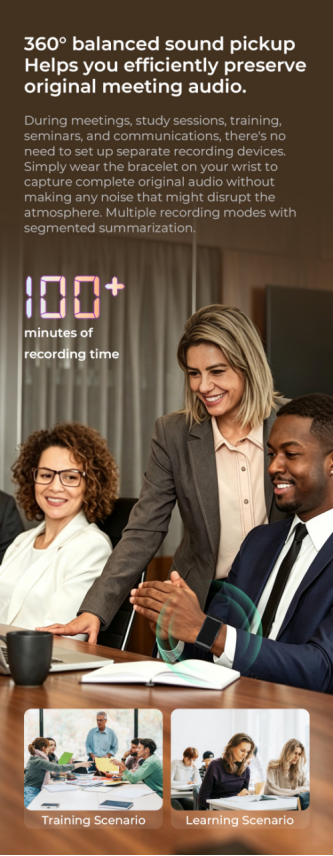
The recorder in use: 360-degree balanced pickup, 100+ minutes of continuous recording, and the same hardware for meetings, training and study sessions.
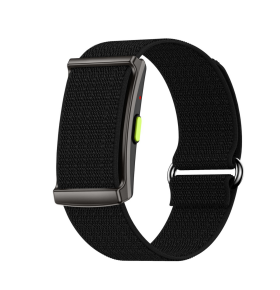
The B20 Note in black: alloy-and-PC case, woven strap, and the green recording key on the side of the case.
2. IP68 Waterproof with no port to leave open
The B20 Note is sealed to IP68, with the microphone port protected by an acoustic membrane and the charging path sealed behind a magnetic connection rather than an open socket. In practice that covers the conditions a wrist device actually meets: hand-washing, rain, sweat during a recorded session and a shower at the end of the day.
Charging is magnetic, about two hours to full from a 200 mAh lithium polymer cell, and the daily-use figure is up to 30 days with standby extending to roughly 45 days. That run-time is what makes the recorder usable as a recorder: a device that needs a charge every third night is a device people stop wearing to meetings.
3. 24/7 Health Monitoring without asking the wearer to change habits
The health side runs on an HX3918 optical sensor with an SC7A20H accelerometer and reports through the Da halo app: whole-day heart-rate trend and history, a seven-measurement trend view, whole-day HRV with a sleep-average figure, blood oxygen including night-time readings, stress with history, cycle tracking with ovulation and prediction, activity with distance, calories, steps and a 7-day goal, and sleep with 24-hour data, stage proportion, a quality score, average sleeping heart rate, average HRV, temperature difference and automatic nap detection. Sedentary, low-battery and heart-rate notifications close the loop.
The sampling interval is the line that makes continuous monitoring defensible on a battery this size: heart-rate monitoring can be set at 5, 10, 30 or 60 minute intervals, so the same hardware serves a market that wants dense overnight detail and a market that wants the longest possible run-time claim.
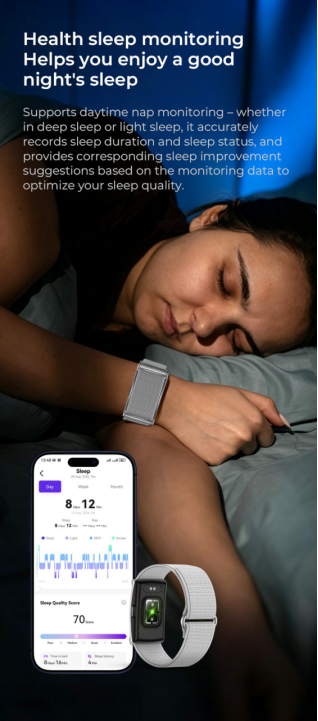
Sleep is where continuous wear pays off: 24-hour sleep data, stage proportion, a quality score, average sleeping heart rate and HRV, and automatic nap detection.
4. 100 languages, two translation modes, one summary button
Transcription and translation both run on a 100-language engine inside the app, with the in-app list as the reference. The two translation behaviours are deliberately separate: real-time translation detects the speaker's language and works in both directions, which suits a mixed-language meeting, while simultaneous interpretation fixes a source language and outputs one direction, which suits a presentation or a guided session.
The output side is what a buyer should demonstrate to their own team. A live transcription screen carries a Transcribe tab, a Summary tab and a Segmented Summary tab; the summary extracts theme and key points against a chosen template, and the segmented view splits the transcript by speaker while keeping the full text one toggle away. For a training department, that is the difference between an audio file nobody opens and a document that can be circulated the same afternoon.
5. Built for your brand
B20 Note is positioned for private-label and OEM programs where the recording chain has to stay identical from lot to lot and the product still has to look at home on an office desk rather than in a gym bag. The chipset, sensor set, sealing method and firmware behaviour stay fixed so your approvals and after-sales scripts remain valid, while finish, strap colour and material, logo, packaging, accessory set and app skin are matched to your market.
If your roadmap needs a different language set, a different strap or a bundled accessory, that conversation belongs in the sampling stage: the language set changes the build, and the strap changes the acoustic balance, and both are cheaper to settle before the golden sample is signed than after packaging artwork is on press.
FAQ (Buyer's Quick Reference)
It is a screenless recorder bracelet with a physical recording key, an AI transcription and summary engine in the Da halo app, and a full health-sensing set. The band records on its own, but transcription, summary, translation and every health report are read in the app on Android 7.0 or above and iOS 13.0 or above, connected over Bluetooth 5.4.What exactly is the B20 Note, and does it need a phone?
It is specified as IP68 Waterproof, with the microphone port covered by an acoustic membrane and no open charging socket, so hand-washing, rain, sweat and a normal shower are within its intended use. Test a sample in water for ten minutes, and ask for the per-lot sealing test record, before you commit to a production run.Can it really be worn in the shower and in the rain?
Continuous recording is specified at 100 minutes or more, with 360-degree balanced pickup from a noise-cancelling microphone. A recording duration toggle, configurable from both firmware and the app, lets a program cap session length so a forgotten recording cannot run past the limit you set.How long can one recording be, and what happens at the limit?
100 languages for transcription and for translation, with two distinct modes: real-time translation that detects the speaker's language and works bidirectionally, and simultaneous interpretation that fixes a source language and outputs one direction. The in-app list is the authoritative reference for a given build.How many languages, and can it translate live?
Heart rate with whole-day trend and history, HRV with a sleep average, blood oxygen including night readings, stress, a female cycle tracker, activity with a 7-day goal, and sleep with 24-hour data, stage proportion, quality score and automatic nap detection. Heart-rate sampling can be set to 5, 10, 30 or 60 minute intervals, which is what allows 24/7 Health Monitoring on a 200 mAh cell with up to 30 days of use.What does it measure, and how often?
These are quoted per project, because language set, strap, finish, packaging and accessory bundle all move both cost and schedule. Send target quantity, destination market, the languages you need and the packaging you plan to offer, and we will quote against that configuration rather than against a generic price list.What about price, MOQ and lead time?
Let's Discuss Your Project
If you are planning a recorder band for a 2026 or 2027 programme, the fastest route to a useful answer is to send five things: the languages your market needs, whether the primary use is meetings, training or study, your target retail price, your estimated quantity, and the packaging or accessory set you intend to offer. With those we can tell you which build fits the price you have to hit, which lines can be held stable across lots, and arrange a sample you can test against the recording, transcription and sealing claims on this page.
Tell us how your customers will actually use it - a two-hour meeting room, a lecture hall, a night of sleep - and the specification stops being a table of numbers and becomes a programme you can defend on the shelf and in after-sales.
Contact us
Send your requirement to the contact below, and please include target quantity, destination market, required languages and the packaging set you plan to offer so we can reply with the right configuration and a quotation on the same page.
Website: www.szmorrison.com
Email: sales06@szmorrison.com
WhatsApp: +86 17318011665

Quick Links
Contact us
Categories