
POV shooting POV shooting AI smart glasses With a Leather Charging Case: How Global Buyers Should Choose a Ray-Ban-Style AI Glasses Supplier in 2026
Introduction: Why This Question Matters to You
Two requirements now arrive in the same sourcing brief: the frame shape your customers already recognise, and an AI camera that keeps working after the novelty wears off. In 2026 almost every factory pitch says "POV shooting AI smart glasses." Far fewer can show you a stable product, a working app, and a charging case finished well enough to sit on a retail shelf.
If you are a brand owner, distributor or tech retailer evaluating AI camera glasses, the risk is rarely the frame silhouette. It is the gap between the sample and the shipment: camera output that shifts between lots, an app that loses its AI partner, or a leather case that looks premium in photos and cheap in the hand.
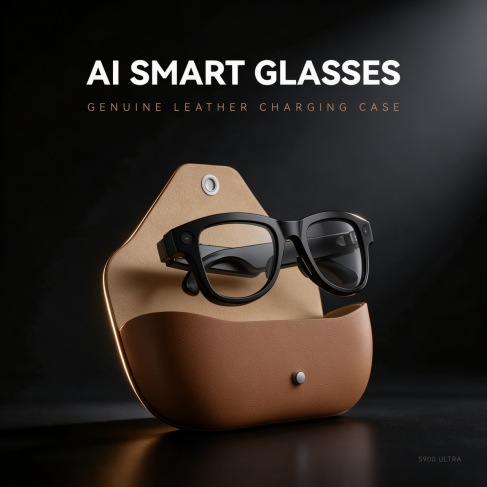
S900 Ultra AI camera smart glasses with a genuine leather charging case.
Shenzhen is still the right place to solve this, because engineering speed here is real. But speed only pays off when you can verify what you are buying. This guide explains the key concepts, the criteria worth comparing, and the practical path from sample to bulk order, so you can judge a supplier on evidence instead of adjectives.
Section 1: Key Concepts Every Buyer Should Understand
What are AI camera smart glasses?
AI camera smart glasses put a camera, two microphones, a speaker and a Bluetooth/Wi-Fi link into an ordinary-looking eyewear frame, with no display and no waveguide optics. The wearer captures photos and video by voice or a single hidden button, listens to calls and music through the temples, and reviews the results in a companion app. Because there is no optics module, the frame can stay slim, the bill of materials stays affordable, and the product can be sold as eyewear rather than as a gadget.
Why the Ray-Ban-style frame matters
The classic wayfarer silhouette, the shape buyers usually describe as Ray-Ban-style, is the geometry the market already accepts: thick front rims, a slim bridge, squared-off lenses. On the S900 Ultra the front and temples are ABS+PC with a high-gloss spray finish, the frame measures 152 mm across, temples 155 mm, lens height 55 mm, and the eyewear alone weighs 54 g. Those thick rims do a second job, housing the camera module, the hidden key and the antenna without visible seams. Lens options are photochromic, sunglasses or clear, so a single platform can cover several SKUs in one catalogue.
What a leather charging case actually adds
A 290 mAh cell in the glasses is honest for a 54 g frame, but it is not enough for a full day of recording. The charging case is the answer: a 1400 mAh 3.7 V battery built into a genuine leather glasses case with a magnetic clasp. It recharges the glasses about four times, restores the frame in roughly 1.5 hours, and refills itself in about 2 hours from the included cable.
The case does three jobs at once, storage, protection and power, which is why experienced buyers treat it as part of the product rather than an accessory. The complete set weighs 398 g and ships in a retail box of 182 x 78 x 88 mm, so the glasses and case display and travel as one unit.
What AI features buyers now expect
The baseline has moved beyond voice commands. On this platform the wake word ("Hey Jack") opens a Google-backed AI assistant, and a voice command or the shortcut key triggers AI image recognition: photograph a menu, a plant or a document and ask what it is. The same assistant handles AI chat, meeting minutes, and an AI notebook that stores what you say in the app and reminds you later. Simultaneous interpretation and dialogue translation are Microsoft-based, and firmware updates arrive over the air through the app.
Language coverage is where spec sheets usually go vague. The S900 Ultra lists 30 languages for the app and the AI assistant, and 38 for real-time translation. Ask any supplier for the actual list rather than the headline count, and test two languages you actually sell into.
Camera, chips and build
The camera is a Sony IMX219, an 8MP sensor, recording 1200P video with EIS anti-shake and an LED flash. A single clip is capped at 12 minutes, which is a thermal decision, not a limitation of the sensor. The main chip is JL7018F6 with a V821 companion, 4 GB of storage, Bluetooth 5.3, Wi-Fi 4, two silicon microphones with noise reduction, and a 1609 speaker rated 0.15 W at 16 ohms. Swipe control on the temple adjusts volume during music playback, and wear detection pauses playback when the glasses come off.
Runtime is stated plainly: 6 to 7 hours of music playback or about 50 minutes of continuous video recording, with the case available for four more charges.
Section 2: How to Compare Suppliers, Criteria, Risk Points and Checklist
Use this checklist on every quotation you receive. Each line guards against a mistake that only appears after the container has shipped.
Checkpoint | What to verify | Red flag |
Frame, fit and finish | Real dimensions and weight (for example 152 mm front, 54 g); even high-gloss spray; hinge stiffness and temple alignment | Photos of a different frame family, or no weight figure at all |
Lens platform | Which lens sets actually ship (photochromic, sunglasses, clear) and whether prescription insertion is possible | "Any lens you want" with no sample to check |
Camera and video | Named sensor (for example Sony IMX219, 8MP), video resolution (1200P), clip length cap, stabilisation and flash | "HD camera" with no sensor name or resolution |
AI stack and languages | Named AI partners (Google assistant, Microsoft interpretation), wake word, and the written language list | An "AI" badge with no partner and no language list |
Charging case | Case cell capacity (mAh), number of full charges, recharge time, contact and lid design, leather grade | "Charging case available" with no capacity or cycle count |
Battery and thermal | Glasses cell capacity, music and video runtime, behaviour during long recording sessions | "All-day battery" with no numbers behind it |
Chipset and memory | Named main and companion chip, storage size, Bluetooth and Wi-Fi versions | Unnamed or "custom" chipset |
App and firmware | App name, supported OS versions, over-the-air update path, account and privacy handling | No app demo on the sample you were sent |
OEM/ODM scope | Logo placement, packaging, leather colour, lens mix, firmware and app naming | "Standard packing only" |
QC and documentation | In-house test items, batch functional test, pre-shipment report, documents the supplier actually holds | No QC step described, or certificates described as "coming soon" |
Trust rule. A reliable supplier describes a real sensor, a named AI partner, a real cell capacity and a real quality step, and will send the files it actually holds. If a certification is not held, a trustworthy partner does not claim it. Before approving artwork, ask to see the app running on the sample you were shipped.
Section 3: From Sampling to Bulk Order, How It Usually Works
1. Sampling
Request evaluation samples in the lens and case colour you intend to sell. On AI eyewear, check four things before you commit: camera output on skin tones and mixed indoor light, wake-word response in a noisy room, the case charging from empty to full with a timer, and two hours of continuous wear to judge weight and temple pressure. Ask for the exact firmware version on the sample so the production build can be matched.
2. Customisation and OEM/ODM
For a private-label programme you will normally specify logo placement on the temple and the case, retail packaging, leather colour, lens tint, and the app or firmware naming. Agree in writing what the sample price includes and what counts as a chargeable revision, because artwork rounds are the most common source of schedule slip.
3. Bulk production
Confirm MOQ, lead time, payment terms and Incoterms before the purchase order, not after. Carton data helps you cost freight early: 25 pieces per carton at 10.9 kg per carton for this product.
4. Quality control and delivery
Ask how inspection is performed, whether it is in-house, third-party or pre-shipment, and what documents travel with each shipment. For AI eyewear, insist on a functional test per batch covering camera, microphones, speaker, charging case cycle and app pairing. A visual check alone will not catch a microphone that has drifted out of spec.
Note. MOQ, lead time and price depend on quantity, lens mix and destination market. We confirm exact terms against your requirements rather than publishing numbers we cannot guarantee.
Section 4: Introducing the S900 Ultra POV shooting AI Smart Glasses
The S900 Ultra is our answer to the criteria above: a Ray-Ban-style AI camera frame sold as a set with a genuine leather charging case, built for buyers who need one platform to cover several retail price points.
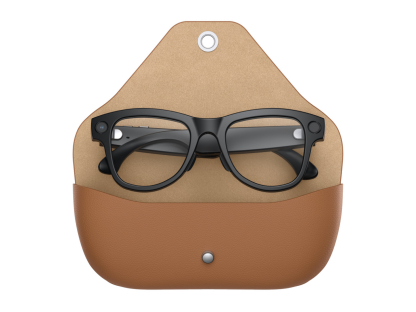
S900 Ultra in the tan leather charging case, front view.
1. A frame that reads as eyewear, not hardware
ABS+PC high-gloss front and temples, 54 g on the face, three lens options, and a single hidden key that handles power and capture. Wear detection pauses music when the glasses come off, and a swipe on the right temple adjusts volume. The point is that the product disappears into normal use, which is exactly what retail buyers ask for when they compare an AI camera frame with a conventional pair of sunglasses.
2. The case is the power system
The leather case carries a 1400 mAh battery that returns roughly four full charges to the 290 mAh glasses. The glasses refill in about 1.5 hours, the case in about 2 hours, and the magnetic clasp closes with the frame inside, so the set can be carried in a bag without a second hard case. For distributors this is the simplest story to tell at shelf level: buy the glasses, and the case keeps them running through a multi-day trip.
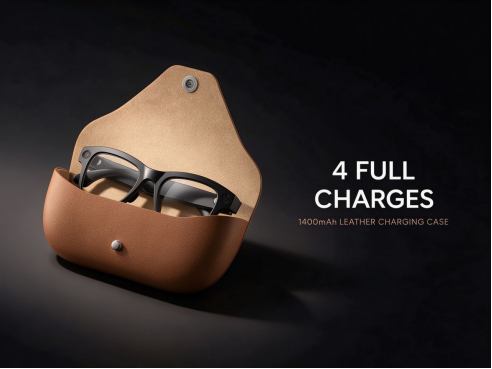
1400 mAh genuine leather charging case, about four full charges for the glasses.
3. 8MP Sony imaging with stabilisation
A Sony IMX219 8MP sensor records 1200P video with EIS anti-shake and an LED flash, with each clip limited to 12 minutes. Photos and video transfer to the app over Wi-Fi, and firmware updates are delivered in-app. For content teams, the practical combination is voice capture without touching the frame, stabilised walking footage, and a case that keeps the set charged between locations.
4. AI assistant, translation and meeting minutes
The platform pairs a Google-backed AI assistant with Microsoft simultaneous interpretation and dialogue translation, plus meeting minutes and an AI notebook. Real-world use cases are straightforward: a buyer on a factory visit records the meeting and gets a summary; a traveller asks the glasses to translate a sign; a sales team photographs a competitor display and asks the assistant what it shows.
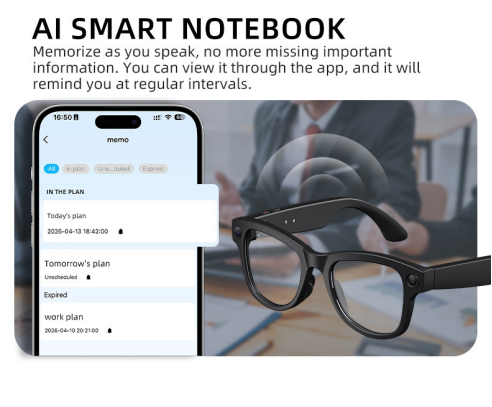
AI notebook in the OneAI Glass app: spoken notes are stored, listed and reminded.
5. App, storage and what ships in the box
The OneAI Glass app runs on Android 8.0 and later and iOS 13 and later, with 4 GB of on-board storage, Bluetooth 5.3 and Wi-Fi 4. The retail set contains the glasses, the leather charging case, a charging cable, a cleaning cloth and a quick-start guide.
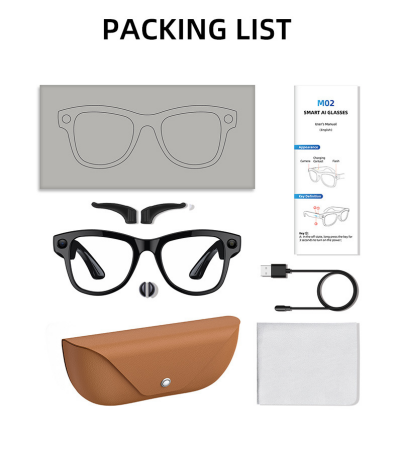
Retail packing list: glasses, leather charging case, cable, cloth and quick-start guide.
Built for your brand
The S900 Ultra is OEM/ODM ready: your logo on temple and case, your packaging, your leather and lens mix, and your app naming. Samples are available in multiple configurations so you can validate camera output, AI behaviour and case performance before committing to volume.
FAQ (Buyer's Quick Reference)
Q: What are AI camera smart glasses? They are ordinary-looking eyewear frames with a built-in camera, microphones, speaker and Bluetooth/Wi-Fi link, but no display. The S900 Ultra uses a Ray-Ban-style wayfarer front with the camera and hidden key built into the rims.
Q: What does the leather charging case actually do? It stores, protects and charges the glasses. The case holds a 1400 mAh 3.7 V battery and returns about four full charges to the 290 mAh glasses inside.
Q: How many times can the case charge the glasses? About four full charges. The glasses recharge in roughly 1.5 hours and the case in about 2 hours.
Q: What camera and video specification does the S900 Ultra use? A Sony IMX219 8MP sensor recording 1200P video, with EIS anti-shake, LED flash and a 12-minute cap per clip.
Q: How long does the battery last? 6 to 7 hours of music playback, or about 50 minutes of continuous video recording, extended by four charges from the case.
Q: Which languages are supported? The app and AI assistant cover 30 languages, and real-time translation covers 38. The full list is available on request so you can check the languages your market needs.
Q: Can we brand the S900 Ultra as our own? Yes. Logo, packaging, leather colour, lens mix and app naming can all be customised, and samples can be supplied in several configurations.
Let's Discuss Your Project
To help you move forward, please share:
· Target market and price point: your target market and the retail price you are planning
· Order quantity: your estimated first order and annual volume
· Customisation: logo, leather colour, lens mix and packaging direction
· Technical requirements: any drawings, test standards or app requirements you already hold
We will reply with the full specification, the language list, the compliance documents we actually hold, and a tailored quotation based on your requirements.
🌐 Website: www.szmorrison.com
📧 Email: sales06@szmorrison.com
📱 WhatsApp: +86 17318011665
Shenzhen Morrison Technology Co., Ltd, Smart Wearable, Better Health.

Quick Links
Contact us
Categories