
Electrochromic POV shooting AI smart glasses With 4-Level Tint Control: How Global Buyers Should Source an AI Camera Glasses Supplier in 2026
The four-level adjustment is more practical than simple on/off, covering different scenarios such as bright cloudy days, glass curtain hallways, midday sunlight, and tunnels. It also facilitates buyers to take photos for comparison and quantification of batch drift under fixed lighting conditions. In terms of commercialization, a changeable color lens replaces the two SKUs of clear lenses and sunglasses, reducing packaging, instructions, and spare parts lists; for optometry retailers, the S711 also supports optional magnetic prescription lens inserts, allowing for both vision correction and color-changing functionality.
In terms of imaging and AI, the S711 is equipped with an 8-megapixel Sony IMX219 sensor and a four-element optical lens, supporting 1080P video recording. Photos and videos both apply EIS stabilization, with a shooting response of approximately 0.8 seconds. Static photos can be interpolated to 32 million pixels. The processing is shared by the JL7018 and V821L2 dual chips, with 2GB of internal storage. Photos, videos, and audio are transmitted via Wi-Fi to the phone, and Bluetooth handles calls and music. The AI assistant is awakened by "Hello Echo" or "Hello Xiaoke", supporting object recognition, question answering, and translation. Translation covers text, conversation, simultaneous interpretation, and face-to-face modes, covering 100+ languages. The application interface provides 13 languages. Additionally, it has AI memory, one-click AI editing, and comic diary modes.
In terms of hardware, the frame uses TR material, black spray treatment, and flexible metal hinges that fit approximately 130 to 160 millimeters of head width. The size is 155×152×50 millimeters. The 290mAh polymer battery supports approximately 8 to 10 hours of music playback and 5 to 7 days of standby. It supports Type-C charging and is protected by IP66 through epoxy sealing, preventing dust, water, and sweat. The packaging includes glasses, charging cable, storage bag, cleaning cloth, two pairs of ear pads, eight-language instructions, and retail packaging box.
When comparing suppliers, the focus should be on lens type (whether it is a true electrochromic battery rather than a photochromic coating), the number of color adjustment levels, control gestures, level stability, optical quality, prescription lens support, sensor and video specifications, chips and storage, AI and language, audio, power and sealing, packaging and documentation. It is recommended to request a sample that can be retained for one week, a specification table with native rather than interpolated data, and a written statement guaranteeing parameter consistency per batch, and take four photos of each level under fixed lighting conditions for comparison.
From prototyping to mass production, start with a working sample as a reference standard, test the four levels of adjustment according to the consumer usage sequence, operate with dual-finger rather than fingernails, and repeat the gestures when the hands are slightly damp; take photos of each level before the fixed gray card for subsequent value comparison; test the camera in the indoor and outdoor environment in the afternoon. The customization mainly focuses on the brand and packaging, rather than the optical stack itself. The price, order quantity, and delivery date for mass production are confirmed based on the project, and the approved samples, packaging design, and instruction text should be locked as soon as possible. Quality control suggestions include: uniformity of four color tones under fixed lighting, resolution tests for photos and videos, real call tests for microphones and speakers, sampling IP66 sealing tests, and packaging box drop tests.
S711 is targeted at the private label and OEM projects. The lens platform remains fixed to maintain product recognizability. The brand, packaging, documentation and accessory kits can be matched according to market demands. Interested buyers can provide the target frame style, estimated quantity, target market and existing technical drawings or packaging references, so as to obtain complete specifications, language list, compliance documents and customized quotations.
Introduction: Why This Question Matters to You
Almost every new POV shooting AI smart glasses pitch in 2026 mentions a tinted lens. Very few mention a lens the wearer can change. That gap is where the category is actually being decided: a fixed sunglass lens forces your customer to own two products, one for indoors and one for sunlight, while a genuine electrochromic lens lets one pair move between an office meeting, a factory floor and a construction site without a lens swap or a second frame.
If you are a brand owner, distributor or optical retailer assessing suppliers, the risk is not whether a factory can print the word "electrochromic" on a box. It is whether the lens in the sample you approve is the lens that ships: whether four tint levels still read as four levels two hundred pairs later, whether the gesture that drives them works with cold or slightly damp fingers, and whether the camera and AI claims printed beside them survive a buyer's first afternoon of testing.
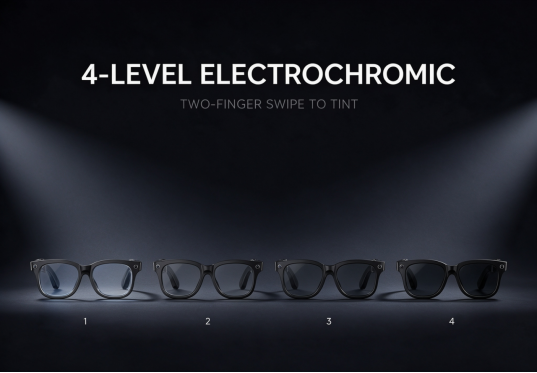
Four electrochromic tint levels on one frame, changed by a two-finger swipe on the temple.
This guide explains what an electrochromic lens actually is, why four discrete levels matter commercially, what to compare between suppliers, and how a sample usually turns into a repeat order. It uses the S711 platform as the worked example, because that product is built around exactly this feature.
Section 1: Key Concepts Every Buyer Should Understand
What an electrochromic lens actually is
An electrochromic lens is a small electrochemical cell laminated into the lens. A thin electrochromic film sits between two transparent conductive layers, and a low voltage drives ions into that film, which darkens it; reverse the voltage and the tint clears. The important difference from a photochromic lens is control. A photochromic lens reacts to ultraviolet light on its own schedule, which means it darkens under a car windscreen, stays dark indoors for minutes and cannot be commanded. An electrochromic lens does what the wearer tells it to do, immediately or in steps, regardless of the light around it.
That distinction is also the first filter in supplier selection. Photochromic treatment is cheap, widely available and easy to source; a working electrochromic cell needs a controlled lamination process, a driver circuit and a touch interface, and those three have to stay aligned across production. A supplier who cannot explain how the cell is driven, or who describes the feature as a coating, is not selling you electrochromic.
Why four levels matter more than on-off
A single darkening step looks impressive in a video and frustrating in daily use. Real conditions are not binary: a bright overcast morning, a showroom with glass walls, direct midday sun and a tunnel all need different amounts of tint. Four discrete levels give the wearer useful presets, roughly a clear state, a light tint, a mid tint and a dark state, so the same pair stays comfortable in more places.
Four levels also make the feature demonstrable and testable, which matters to you as a buyer. You can photograph the same frame at each level under fixed lighting, compare it against a reference sample, and put a number on drift between lots. A two-state lens leaves you with a subjective judgement; a four-state lens gives you something a QC sheet can record.
How the wearer controls it
On the S711 the tint is driven from the touch strip on the right temple: a two-finger swipe steps the lens through the four levels, while a single-finger swipe adjusts volume. Two physical buttons handle power and capture. The gestures are separated by finger count, which sounds like a small detail until you watch people try to lower the volume on a pair of glasses in a noisy room. Nothing about the tint needs a phone, and the app, DA ECHO, is where settings, gallery transfer and firmware updates live.
In everyday use the wearer sets a level for the conditions and leaves it; the control is a step adjuster rather than a momentary dimmer. That is the behaviour worth testing in your sample review: does one swipe advance exactly one level, does the lens settle rather than drift, and does the level hold when the wearer walks from shade into sun.
Why one pair replaces two SKUs
Clear-to-dark on demand changes the commercial maths. A distributor who previously stocked a clear frame and a sunglass frame for the same customer now stocks one SKU with one set of packaging, one manual, one spare-parts list. For an optical retailer the proposition is stronger still: the S711 accepts an optional magnetic prescription insert, so a prescription wearer clips their own correction inside the frame and keeps the electrochromic function on top of it. One frame then covers clear indoor use, tinted outdoor use and corrected vision.
The camera and AI stack behind it
A tint feature alone does not sell in 2026, so the imaging and AI layers have to hold up. The S711 uses a Sony IMX219 sensor at 8 megapixels with a four-element optical lens, records 1080P video, and applies EIS stabilisation to both photos and video. First-person capture is what glasses are good at, and the shutter is tuned for it: the capture path is quoted at 0.8 seconds, so the shot happens close to the moment you decide to take it rather than a second later. Stills can also be output at 32 megapixels through interpolation when a larger file is needed for print or crop.
Processing is split across two chips, a Jieli JL7018 handling the audio and system side with an Allwinner V821L2 taking the imaging load, with 2GB of storage on board. Photos, video and audio recordings transfer to a phone over Wi-Fi rather than a cable, and Bluetooth handles calls and music through the temples.
The AI layer is triggered by voice. The wake words are "Hello Echo" and "Hello Xiaoke", and from there the wearer can ask the glasses to identify what the camera is pointed at, ask a question and hear the answer, or run a translation. Translation is offered in four modes, text, dialogue, simultaneous interpretation and face-to-face conversation, with more than 100 languages covered on the translation side; the app interface itself ships in 13 languages including Simplified and Traditional Chinese, English, Spanish, French, German, Italian, Japanese, Korean, Portuguese, Russian, Arabic and Hindi. The platform also carries AI memory, one-tap AI editing of photos and video into a finished clip, and a comic-diary mode that turns photos into illustrated pages, which are the features that tend to decide whether a buyer keeps using the product after the first week.
Power, sealing and frame
The frame carries a 290 mAh polymer cell and charges over Type-C, quoted at about 8 to 10 hours of music playback with 5 to 7 days of standby. Ingress protection is IP66, achieved with dispensed adhesive sealing rather than a rubber gasket, so the frame stays dust-tight, water-resistant and sweat-resistant without thick joints. The front and temples are TR, a tough resilient material, finished in sprayed black, with flexible temples on all-metal hinges that the measurement sheet states will fit head widths from about 130 to 160 mm. Measured as 155 x 152 x 50 mm, the frame reads as a normal thick-rim optical frame rather than a device.
Section 2: How to Compare Suppliers, Criteria, Risk Points and Checklist
Supplier conversations tend to collapse into a single question, which is price. That question is answerable only after three others: is the lens real, is the camera consistent, and can the factory hold both across a production run. The table below turns those three into something you can check with a sample and a spec sheet.
What to check | Why it matters | Red flag |
Lens type | Confirm the lens is an electrochromic cell with a driver, not a photochromic coating or a fixed tinted lens. | Supplier cannot describe the cell or the driver; samples darken only under sunlight. |
Number of tint levels | Four discrete levels allow indoor, overcast, bright and direct-sun use on one frame. | Only on and off, or levels that look nearly identical in photographs. |
Control gesture | Two-finger swipe for tint and single-finger swipe for volume, separated so they do not misfire. | Every touch gesture does everything; volume change while adjusting tint. |
Level stability | Each level should settle and stay put while the wearer moves between light conditions. | Tint drifts, oscillates, or creeps darker over an hour. |
Optical quality | Edge distortion and clarity matter to a prescription wearer, not only to a camera user. | No optical test data; tint uneven across the lens area. |
Prescription support | A magnetic insert keeps the electrochromic function usable for prescription customers. | No insert option, or an insert that fouls the lens surface. |
Sensor and video | 8MP Sony IMX219, 1080P recording and a four-element lens are the verifiable baseline. | Resolution quoted only as an interpolated number with no native figure. |
Stabilisation and shutter | EIS applied to photos and video; capture near 0.8 seconds for first-person shooting. | No stabilisation in video; shutter lag over a second. |
Chips, storage and transfer | JL7018 plus Allwinner V821L2, 2GB on board, Wi-Fi transfer of photos, video and audio. | Unnamed chipset; transfer only by cable. |
AI and languages | Wake-word assistant, object recognition, Q&A, four translation modes, 100+ languages on translation. | Language count with no list; features that only work on one phone model. |
Audio | ENC dual-microphone noise reduction with Bluetooth calling through the temples. | Single microphone; call quality unusable outdoors. |
Power and sealing | 290 mAh, 8 to 10 hours of music, Type-C, IP66 with dispensed adhesive sealing. | No IP rating; sealing described only as splash-proof. |
Packaging and documents | Manual in eight languages, storage pouch, cloth, two ear pads, retail box sized for shelf or e-commerce. | English-only manual; no retail box dimensions. |
Ask for the same three things from every candidate: a sample you can keep for a week, a spec sheet with native rather than interpolated numbers, and a written statement of which parameters are guaranteed per lot. Then photograph the frame at all four levels under fixed lighting, compare it to a reference you keep on file, and repeat the comparison when the bulk order arrives. That single habit catches more drift than any promise in a quotation.
Questions worth putting in the first email, before price:
· Lens origin. Which electrochromic cell and driver are used, and who laminates the lens?
· Level definition. How are the four levels defined, and what tolerance is guaranteed at each one?
· Cycle expectation. What switching-cycle figure does the cell supplier publish, and what does the factory test?
· Native figures. What is the native sensor resolution and video resolution, separately from interpolated output?
· Repeatability. Can you send two samples from different lots so I can compare them side by side?
Section 3: From Sampling to Bulk Order, How It Usually Works
1. Sampling
Start with one working sample and treat it as your reference standard. Test the four levels in the order a customer would, using two fingers on the temple rather than a fingernail, and repeat the gesture with slightly damp hands. Photograph each level against a fixed grey card so that later shipments can be compared numerically instead of by memory. Then test the camera indoors and outdoors on the same afternoon, because first-person capture fails most often in ordinary indoor light, not in a demo room.
2. Customisation and OEM/ODM
The S711 ships as a black TR frame with electrochromic lenses, so the customisation surface sits around the product rather than inside the optical stack: brand and packaging artwork, the manual in your market's language or languages, accessory set, retail box and outer carton printing, and the app branding conversation with your account manager. Because the lens is the identity of the product, avoid asking for changes to the cell or the level count unless you are prepared to re-qualify the optics; anything that alters the laminate changes the test basis you just built.
3. Bulk production
Volume breaks, lead time and unit price are quoted per project and depend on the accessory set and packaging you choose, so they are confirmed in writing rather than published. What is worth fixing early is the approved sample, the packaging artwork and the manual text, because those three decide how fast the run moves once the order is placed.
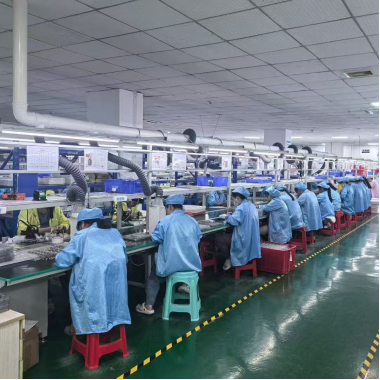
4. Quality control and delivery
A practical inspection list for this product class has five lines: tint uniformity at all four levels under fixed lighting, camera output against a resolution chart in both photo and video modes, microphone and speaker check with a real call, IP66 sealing on a sampled unit, and a drop test on the packed retail box. Ask that the tint photographs taken at sampling are kept with the lot records; the comparison between those and the shipment is the cheapest quality control you will ever run.
Section 4: Introducing the S711 Electrochromic AI Smart Glasses
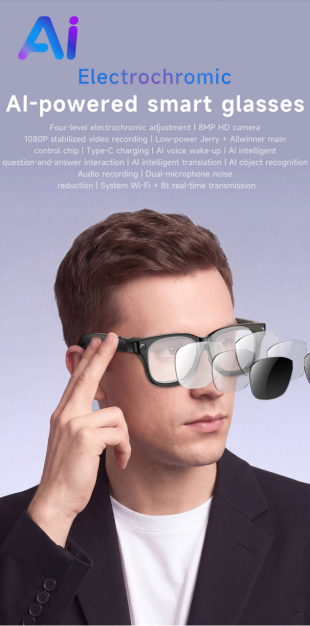
S711 electrochromic AI smart glasses: one frame, four tint levels, an 8MP camera on board.
1. The lens is the product
The S711 is built around a pair of electrochromic lenses with four adjustable tint levels, changed by a two-finger swipe along the right temple. The frame ships in black with those lenses fitted, so the tint range is part of the product story rather than an accessory. Because the same touch strip also handles volume on a single-finger swipe, the wearer can adjust either without looking at the frame, which is the difference between a feature people use and a feature people demo once.
2. Imaging built for first-person capture
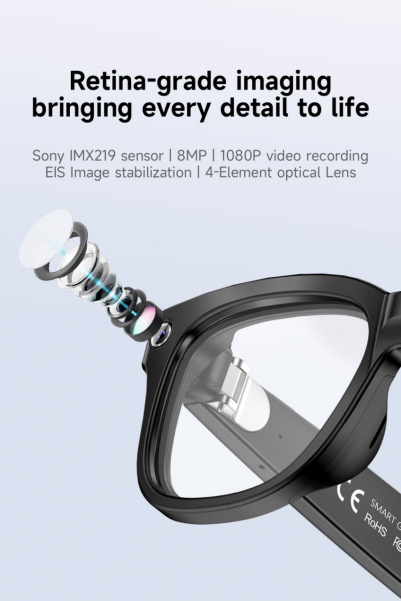
Sony IMX219 sensor, 8MP stills, 1080P video and a four-element optical lens.
Stills come from an 8 megapixel Sony IMX219 sensor behind a four-element optical lens, with 32 megapixel interpolated output available when a larger file is needed. Video records at 1080P, and EIS stabilisation is applied to both photo and video capture, which is what makes handheld first-person footage watchable while walking. The capture path is quoted at 0.8 seconds, and the EIS algorithm is tuned for the first-person perspective with minimal cropping, so the field of view you see is close to the field of view you get.
3. An assistant you talk to

Translation runs in four modes, from text and dialogue to simultaneous interpretation and face-to-face conversation.
conversation.
Wake the glasses with "Hello Echo" or "Hello Xiaoke" and the assistant is available without touching the frame. Point the camera at something and ask what it is; ask a question and hear the answer back through the temples; or open a translation session that runs as text, dialogue, simultaneous interpretation or face-to-face conversation. Translation covers more than 100 languages, and the DA ECHO app interface ships in 13. Around those functions sit AI memory, one-tap editing that turns clips and photos into a finished piece, and a comic-diary mode that renders photos as illustrated pages.
4. Audio, storage and connection

Recording, dialogue translation, meeting minutes and simultaneous interpretation in one workflow.
Two microphones run ENC noise reduction with anti-interference processing, which supports both call noise cancellation and the recording modes shown above. Calls and music play through the temples over Bluetooth, with track switching and pause handled by touch. On-board storage is 2GB, and photos, video and audio recordings move to a phone over Wi-Fi, so nothing depends on carrying a cable to review what you shot.
5. Frame, power and what ships in the box
The frame is TR with a sprayed black finish, with flexible temples on all-metal hinges stated to fit head widths of roughly 130 to 160 mm, and it measures 155 x 152 x 50 mm. A 290 mAh polymer cell gives about 8 to 10 hours of music playback and 5 to 7 days of standby over Type-C charging, and IP66 protection is achieved with dispensed adhesive sealing, so the frame is dust-tight, water-resistant and sweat-resistant. An optional magnetic insert accepts prescription lenses. The box contains the glasses, a charging cable, a storage pouch, a cleaning cloth, two ear pads, a manual in eight languages and the retail packaging, with the colour box at 164 x 70 x 56 mm and the outer carton at 365 x 345 x 328 mm.
Built for your brand
S711 is positioned for private-label and OEM programmes: the lens platform stays fixed so the product keeps its identity, while branding, packaging, documentation and accessory set are matched to your market. If your roadmap needs a different tint presentation or a different accessory bundle, that conversation belongs at the sampling stage rather than after the artwork is approved.
FAQ (Buyer's Quick Reference)
Four levels, stepped by a two-finger swipe on the right temple touch strip. A single-finger swipe on the same strip controls volume, and two physical buttons handle power and capture.How many tint levels does the lens have, and how does the wearer change them?
Yes. The S711 accepts an optional magnetic prescription insert that clips inside the frame, so corrected vision and variable tint work together on one pair.Can prescription wearers use an electrochromic frame?
An 8 megapixel Sony IMX219 sensor with a four-element optical lens, 1080P video recording, EIS stabilisation for photo and video, and 32 megapixel interpolated stills when a larger file is required.What are the camera and video specifications?
About 8 to 10 hours of music playback and 5 to 7 days of standby from a 290 mAh polymer cell, charged over Type-C.How long does the battery last, and how is it charged?
IP66, achieved with dispensed adhesive sealing rather than a gasket, so the joints stay slim while the frame remains dust-tight and resistant to water and sweat.Is the frame protected against dust, water and sweat?
The DA ECHO app, available in 13 interface languages. Photos, video and audio recordings transfer over Wi-Fi, and settings and firmware updates are handled in the same app.Which app does the product use, and how do photos get to a phone?
These are quoted per project and depend on the accessory set, packaging and documentation you choose, so they are confirmed in writing after the specification is fixed.What about MOQ, lead time and price?
Let's Discuss Your Project
If you are evaluating electrochromic AI camera glasses for a 2026 launch, the fastest way to a useful answer is to send your target frame style, estimated quantity, destination market and any technical drawing or packaging reference you already have. With those four inputs we can tell you which tint configuration, accessory set and documentation package fits your channel, and arrange a sample you can test at all four levels before anything is committed.
Tell us what your customers will actually do with the product, indoors, outdoors, and in the languages they speak, and the specification stops being a list of numbers and becomes a product decision.
We will reply with the full specification, the language list, the compliance documents we actually hold, and a tailored quotation based on your requirements.
🌐 Website: www.szmorrison.com
📧 Email: sales06@szmorrison.com
📱 WhatsApp: +86 17318011665
Shenzhen Morrison Technology Co., Ltd, Smart Wearable, Better Health.

Quick Links
Contact us
Categories