
Eight Point Nine Millimetres: How Buyers Should Specify a Slim Round Calling Watch for 2026 Retail
Introduction: Why This Question Matters to You
A round watch that can take a phone call is the most competitive product in the mid-market wearable band right now, and it is also the one where buyers get caught by numbers they did not check. The customer sees a slim case, a bright dial and a call button. What decides whether that product survives its first season is something else: how thin the case actually is once the sensor housing is counted, how many pixels the panel really has, whether the call audio is usable outdoors, and whether the waterproof claim holds after a year on a wrist.
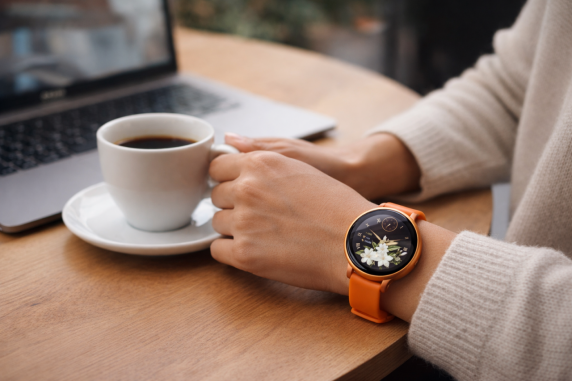
This article works through those decisions using one concrete platform as the reference: the MR525, a round 43 mm calling watch with an 8.9 mm case, a 1.26 inch IPS display, Bluetooth 5.4 dual-mode calling, IP68 protection to 1.5 metres, a 200 mAh cell rated for 3 to 5 days of use, and a Da Fit companion app. Every figure below is taken from the product specification sheet, with the marketing detail pages used only to describe use cases.
If you are sourcing for a value segment, read the display and the audio sections first: those are where a cheap-looking product is made expensive, and where an honest specification protects you from returns. If you are sourcing for a brand that competes on design, read the case and colourway sections first.
The MR525 in Cosmic Orange: a 43 mm round case that measures 8.9 mm at the wall, on a matched silicone strap.
Section 1: Key Concepts Every Buyer Should Understand
1. Slim is a manufacturing figure, not a design adjective
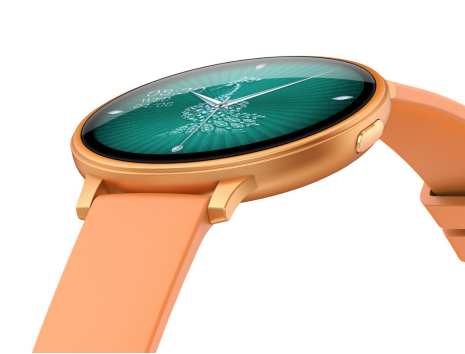
The MR525 case measures 43 mm across and 8.9 mm thick, in PC plus ABS, with an 18 mm silicone strap. That 8.9 mm figure is the one to hold, because case thickness is the attribute buyers quote and factories quietly redefine: some quote the case wall only, some quote the glass to the back of the sensor housing, and one supplier will quote a number that excludes the crown. Ask for the measurement method in writing and measure the sample with a caliper at the crown, at the case wall and across the sensor housing. A 43 mm round watch that measures under 9 mm at the wall reads as slim on the wrist; the same watch quoted at a different reference point reads as ordinary.
The material choice explains the weight that the marketing pages call lightweight without giving a figure. PC plus ABS is a light engineering plastic and it is also the cheapest way to build a round case with a fine bezel line, which is why the specification sheet does not publish a gram weight: there is nothing to boast about, and there is nothing to hide either. Order the measured weight with the strap before you book freight, because on a value programme the shipping weight is a cost line, not a footnote.
The strap is 18 mm, a standard width. That matters commercially for the same reason it does on every other watch in this band: the customer can fit a third-party strap, the retailer can refresh old stock, and a second strap becomes a sellable accessory rather than a spare part you have to warehouse.
2. A 1.26 inch IPS panel at 240 by 240: what the number really means
The display is a 1.26 inch IPS TFT at 240 by 240 pixels, 189 PPI, 500 nits, with OGS touch. Read that honestly. At 189 PPI a watch face with large numerals, a photographic dial or a bold icon set looks perfectly acceptable, which is what this product is for; fine body text and small notification previews will look soft, and no amount of marketing copy changes that. The 500 nit figure is the one that decides whether the dial is legible outdoors, and 500 nits on an IPS panel is adequate in shade and mixed light but marginal in direct summer sun.
Two technical choices in the hardware make the modest panel behave better than its numbers suggest. The chipset carries a 2.5D GPU with multi-layer blending and JPEG decode, so a dial can be composed from several layers without the interface dropping frames, and the OGS touch layer removes the air gap between glass and panel, which is what keeps a 1.26 inch screen readable at an angle. When you compare suppliers, compare the resolution and the touch stack rather than the phrase high-definition display, which appears on every page in this category.
The interface is where this platform spends its design effort. Six menu layouts are selectable (list, honeycomb, helm, ball and array, with list as the default), and eight transition styles run from scaling to horizontal sliding to several flip variants. That variety is inexpensive to produce and expensive to copy badly, and it is what makes a value product feel considered on the shelf. Ask to see at least two menu styles and two transitions on the sample, because a beautiful default view often hides a poorly finished secondary menu.
3. Bluetooth 5.4 dual-mode calling: the feature that carries the price
The MR525 is a calling watch, not a notification mirror. Bluetooth 5.4 dual-mode with a maximum transmit power of 13 dBm carries the audio, so the wearer can answer and end calls from the wrist, with eight contacts stored on the device. The audio chain behind that is worth specifying: a built-in Class-D amplifier rated at 500 mW into 4 ohms, a 16-bit ADC with a 98 dB signal-to-noise ratio, and support for SBC, AAC, CVSD and mSBC codecs. In plain terms, the speaker has enough headroom to be intelligible in a quiet room, and the microphone path has a low enough noise floor that the person on the other end is not listening to a hiss.
What buyers should test in person, because no sheet tells you: call intelligibility at arm's length in a room with background noise, the delay between pressing answer and hearing audio, whether the watch keeps the link when the phone is in another room, and how the volume steps behave. A calling watch that is 20 percent cheaper per unit and unintelligible outdoors is not cheaper; it is a return rate.
Bluetooth 5.4 also matters for pairing behaviour. On Android 6.0 and above and iOS 9.0 and above, the higher version generally pairs faster and holds a link at lower power, which is part of why the 200 mAh cell can carry a calling product at all. Confirm pairing on one older Android build and on the current iOS release before you sign a purchase order, because permission prompts on recent iOS versions are the most common source of support tickets on calling watches.
4. IP68 Waterproof at 1.5 metres and the sealing arithmetic
The MR525 is rated IP68 with a stated 1.5 metre water resistance. For a calling watch that figure matters more than on a fitness band, because a device with a microphone and a speaker has openings in the case that a sensor-only band does not. That is the whole reason an acoustic device needs a carefully specified membrane over the microphone port and a sealed speaker chamber, and it is why the IP68 claim should be supported by a report naming the exact model, the depth and the duration.

In use, IP68 to 1.5 metres covers hand-washing, rain and a sweaty session, and it does not cover swimming or showering at pressure. Say so in your product copy. The most common after-sales complaint on calling watches is not a failed seal but a customer who swam with a device described as waterproof without a condition, and that complaint is settled against you, not against the factory.
Three details to verify on a sample: the microphone membrane, the speaker chamber seal and the charging contacts. The MR525 charges magnetically at DC 5V through a built-in 300 mA charge management controller, which means there is no open USB socket to leak, a genuine advantage on a slim acoustic case. Ask whether the charging contacts are gold-plated and how they are sealed, because pogo pins on a 8.9 mm case are where water enters after a year of use.
5. 24/7 Health Monitoring with stress and cycle tracking
Health tracking on this platform is a sensor plus an algorithm plus a display, and the sheet names all three: a Vcare heart-rate sensor supporting biometric detection, an ST LIS2DOCTR accelerometer running the Gomore algorithm, and a dedicated sensor hub with its own 32-bit CPU at 24 MHz for low-power wake-up. The feature set that comes out of that is continuous heart rate, sleep monitoring, stress tracking, menstrual cycle reminders, sedentary reminders and hydration reminders.
The stress and cycle features are what separate this from a step counter, and they are also what makes 24/7 Health Monitoring a claim you can stand behind in front of a retail buyer: continuous heart rate gives the trend, sleep gives the recovery picture, stress gives the daytime story, and the cycle reminder replaces a separate app. Present them as trends rather than measurements. A wrist optical sensor is not a medical instrument, and the wording on your product page should not suggest otherwise.
One documentation detail to settle before artwork: the highlights block of the specification sheet names the heart-rate sensor as VC30F-SG, while the hardware table names it as Vcare HX3602. These are probably the module family and the die inside it, but they are two different strings, and a product page that quotes the wrong one is the kind of detail a technical buyer will catch. Ask the supplier which string belongs on the packaging insert, and put the same string in the manual.
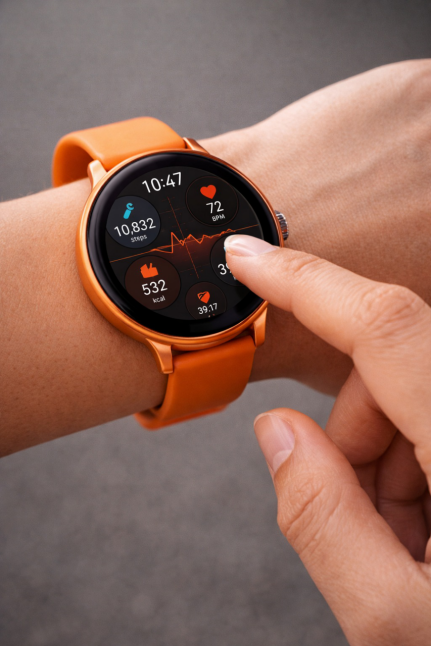
Heart rate, steps, calories and active minutes on the wrist: the daily view the health features are built around.
6. 123 sports modes, 3 to 5 days and 13 languages
Sports coverage runs to 123 modes with automatic sport recognition and track recording, backed by step, calorie and distance counting. The number is large because modes are cheap to add and easy to merchandise, so the useful check is not the count but the visible list: make sure the modes your poster advertises actually appear in the device menu, and that the three or four your customer will use most sit near the top of the list rather than buried in a submenu.
Endurance is a 200 mAh cell in an ST 402030 package, rated at 0.814 Wh, giving 3 to 5 days of use and 12 to 18 days of standby, with magnetic charging at DC 5V and a 300 mA charge controller inside. On a calling product the low end of that range is the honest number for a wearer who takes a few short calls a day, and the high end assumes notification-only use. Write both conditions into the purchase order so that the field result is predictable.
Language support is 13 built-in watch languages, English, Chinese, Japanese, Korean, German, French, Spanish, Arabic, Russian, Portuguese, Indonesian, Thai and Vietnamese, with the Da Fit app covering the major global languages on both Android and iOS. If your market is not on that list, decide now whether the watch interface can ship in English with a localised app, because adding a device language is a firmware project rather than an artwork change.
Section 2: How to Compare Suppliers, Criteria, Risk Points and a Checklist
With the case, panel, audio and sealing decisions settled, supplier comparison becomes a matter of documents and samples rather than adjectives. The table below sets the MR525 platform against the questions you should be able to answer for any competing quotation.
Parameter | MR525 specification | What to verify and why it matters |
Case and thickness | 43 mm round, 8.9 mm thick, PC plus ABS, 18 mm strap | Agree the thickness reference point in writing and caliper the sample at the crown, the wall and the sensor housing; measured weight is not published and should be requested |
Colours | Cosmic Orange and Midnight Black per the specification sheet; the marketing pages also show a champagne gold variant | Confirm which colourways are actually available before you design packaging or plan a colour wall |
Display | 1.26 inch IPS TFT, 240 by 240, 189 PPI, 500 nits, OGS touch | Compare resolution and touch stack rather than the phrase high-definition; check legibility outdoors in shade and in direct sun |
Calling | Bluetooth 5.4 dual-mode, 13 dBm maximum transmit power, answer and end calls, 8 stored contacts | Test intelligibility at arm's length in a noisy room, the answer delay and link stability with the phone in another room |
Audio path | Class-D amplifier 500 mW into 4 ohms, 16-bit ADC with 98 dB SNR, SBC, AAC, CVSD and mSBC support | Ask for the codec list in writing; codec support decides whether the call sounds clear on both phone platforms |
Water resistance | IP68, 1.5 metres; magnetic charging at DC 5V with a 300 mA charge controller | Obtain the IP68 report naming the model, depth and duration, and inspect the microphone membrane, speaker chamber and contact sealing |
Chipset and memory | JL AC7076, 32-bit dual-issue DSP at 288 MHz, 284 KB SRAM with FPU, NOR flash 32 Mb, 2.5D GPU with JPEG decode | Verify the chipset and flash size; flash decides how many watch faces and languages fit, and the GPU decides whether dials animate smoothly |
Health sensors | Vcare heart-rate sensor supporting biometric detection, ST LIS2DOCTR accelerometer with the Gomore algorithm, independent sensor hub | Resolve the sensor naming difference between the highlights block and the hardware table, and test heart rate against a chest strap |
Battery and charging | ST 402030 cell, 200 mAh, 0.814 Wh; 3 to 5 days of use; 12 to 18 days standby; magnetic DC 5V charging | Confirm the cradle ships in the box and the same cradle charges both colours; fix the call and notification counts used for the runtime figure |
Compatibility | Android 6.0 and above, iOS 9.0 and above | Pair on one older Android build and the current iOS release; permission prompts differ and both need to be scripted in the manual |
Languages | 13 watch languages built in; Da Fit app covers major global languages | Confirm the on-device list separately from the app list, and decide whether a missing language is a blocker for your market |
Sports | 123 modes with sport recognition and track recording, plus step, calorie and distance counting | Check that the advertised modes appear in the device menu and that the popular ones sit near the top of the list |
Interface | Six menu layouts including list, honeycomb, helm, ball and array; eight transition styles; watch face market and custom faces | View at least two menu styles and two transitions on the sample; the default view often hides a weak secondary menu |
Packaging data | Not published in the specification sheet | Request measured single-set weight, carton dimensions and carton gross weight before booking freight; quote them per project |
Two rows are worth pulling out. The colour row is a genuine gap between documents: the specification sheet lists Cosmic Orange and Midnight Black, while the marketing detail pages show three colourways including a champagne gold version. Until the assortment is confirmed, plan artwork for the two colours you can defend. The sensor row is a naming inconsistency rather than a hardware conflict, but it has to be resolved before a manual or a packaging insert is printed.
The six points to put in writing before you order
· Thickness reference: the measurement point used for the 8.9 mm claim, the measured weight with strap, and the caliper result on the approved sample.
· Panel specification: 1.26 inch IPS TFT at 240 by 240 with the 500 nit figure and the OGS touch stack, written into the purchase order rather than described in adjectives.
· Call quality acceptance: a simple field test at arm's length in 65 dB background noise, with a pass or fail threshold agreed before production.
· Sealing evidence: an IP68 report naming the exact model, the 1.5 metre depth and the duration, plus a statement that the microphone membrane and speaker chamber are part of the sealed assembly.
· Runtime conditions: the number of calls, notifications and screen-on minutes behind the 3 to 5 day figure, so a field result below 3 days is a fault rather than a debate.
· Assortment lock: which colourways are in the first shipment, and whether the champagne gold version shown in marketing material exists as a sellable SKU.
Where the risk actually sits
Three failure modes account for most of the losses on this type of product. The first is the panel: a 1.26 inch screen of the same size at a lower resolution, indistinguishable in a catalogue photo and obvious in a notification. The second is the audio: a speaker that measures fine on paper and is unintelligible outdoors, usually because the amplifier headroom was trimmed to save cost. The third is the seal: a case that passes IP68 in the laboratory and fails in the field because the microphone membrane was fitted at a station that was not part of the audit.
All three are controlled the same way, by converting promises into evidence. Write the panel resolution, the codec list and the test report reference into the purchase order, keep a signed golden sample, and test the first production lot against it rather than against the render that was used to sell it.
Section 3: From Sampling to Bulk Order, How It Usually Works
For a calling watch the sequence is the same as for any wearable, with one difference that matters: audio and sealing cannot be judged from a datasheet, so the sampling stage carries more weight here than the paperwork does.
1. Sampling
Start with stock samples in both colours, orange and black, and put each on a wrist for a day rather than a minute. A 43 mm round case at 8.9 mm behaves differently on a 15 cm wrist than on a 18 cm wrist, and the colour choice is decided by that fit more than by taste. Ask for a sample with the strap in its production colour, because strap and case are matched in this platform and a stand-in strap changes how the whole product reads.
Then test the two things that a catalogue cannot show. Take a call at arm's length in a room with background noise, and time the delay between pressing answer and hearing the other person. Wash your hands with the watch on, and check the microphone membrane and speaker chamber afterwards. These two tests tell you more about whether the product will survive a season than any specification page.
For a customised sample, allow two to three weeks from artwork approval, and plan on two rounds: the first exists to find problems. When you approve it, keep a sealed golden sample and photograph it under both shop and daylight conditions, so the reference is a physical object and an image you can send to a factory in another country. The audio acceptance test belongs in that approval record as well, with the pass threshold written down.
2. Customisation and OEM/ODM
The MR525 splits cleanly into what is fixed and what your brand decides. Fixed: the case dimensions and material, the panel, the chipset and audio path, the sensor set, the cell and the sealing design, because changing any of them invalidates the water-resistance report and may invalidate CE or FCC documentation. Yours: case and strap colour, logo and its placement, packaging and gift box, the accessory set, the default watch face, the pre-installed face list, the default menu layout and the app skin.
Two customisation requests are common in this category and both deserve an honest answer at the quotation stage. The first is a colour outside the existing range: if the case is painted or plated rather than moulded in colour, a new colourway is an artwork and batch-size decision rather than a tooling one, but the minimum run per colour still applies. The second is an additional device language: adding a language to the watch interface is firmware work with its own test cycle, not a translation exercise, and it should be scheduled as such.
The Da Fit app is the third piece. The supplier ships it as a platform app, so customisation there runs to the skin, the onboarding screens and the default face rather than to the data layer. If your brand needs its own application, that is a separate development project and should be priced separately, because it changes the support model for the whole product life.
3. Bulk production
Plan around the colour mix rather than the total quantity. Two colourways, orange and black, is a simpler problem than six, and the minimum run per colour is what actually constrains the order: a 3,000 unit programme split across two colours is scheduled differently from the same volume in one. Name the lead colourway for the first shipment, and keep the second as a replenishment rather than committing both at the same volume.
A repeat order on this platform typically runs four to six weeks after sample approval and artwork sign-off, and a first order with printed packaging runs longer, because box printing follows its own schedule. The number worth asking for is the production slot date rather than a lead time in weeks; the watch can be ready while the packaging is not, and nobody notices until the ship date.
Order the accessories with the same mix. The magnetic charging cradle is a matched part, so cradles should follow the case colour count; a single-colour cradle becomes an inventory problem the moment a customer buys both colours. If you plan a second strap as a separate SKU, order it as its own line with its own packaging so that it can be merchandised rather than handed over in a poly bag.
4. Quality control and delivery
Agree the inspection plan before the first production run. On a calling watch the four acceptance points are appearance, audio, sealing and display uniformity. Appearance should be judged against the golden sample under defined lighting, with a written cosmetic limit for the bezel and glass, because a moulding mark on a 43 mm plastic case is visible and an unrecorded limit becomes a dispute.
Audio is checked by sampling from each shift and calling from each sampled unit in a quiet room, listening for distortion and for the microphone level. Sealing is checked by sampling from each shift rather than once at the end, because a membrane fitted at one station and not another is a station problem, not a batch problem. Display uniformity is checked with a flat grey image at low brightness, which is the fastest way to reveal uneven backlight and dead pixel clusters that a photographic dial would hide.
For delivery, the documents that decide clearance are the certification file, which for this product means the IP68 report plus CE, FCC and RoHS as the export baseline, and the battery documentation for the 200 mAh lithium cell, which has to match the cell actually fitted. The packaging data that the specification sheet does not publish, single-set weight, carton dimensions and carton gross weight, must be measured and quoted before freight is booked; without those three numbers the landed cost is unknown.
Finally, agree how after-sales will work. A calling watch generates a mix of complaints that a fitness band does not: call audio quality, charging contact corrosion, and battery ageing after a season of daily calls. A spare-parts allowance of 1 to 2 percent, covering straps, cradles and a small number of complete units, is cheaper than air-freighting replacements one at a time in the first quarter.
Section 4: Introducing the MR525 Slim Round Calling Watch
The MR525 is a round calling watch built for the value and mid-market band: a 43 mm case that measures 8.9 mm at the wall, a 1.26 inch display, Bluetooth 5.4 dual-mode calling, IP68 protection to 1.5 metres and a 200 mAh cell rated for 3 to 5 days of use. It is offered in Cosmic Orange and Midnight Black, on an 18 mm silicone strap.
1. A slim case in two colours that photographs well
The case is 43 mm round and 8.9 mm thick, in PC plus ABS, which is the material choice that makes a fine bezel line affordable at this price and keeps the watch light on the wrist. The colourways do different jobs on a shelf: Cosmic Orange is the one that stops a browser in a listing grid and reads as energetic, and Midnight Black is the one that sells to the customer who wants the watch to disappear under a cuff. Plan the wall with both, because the same electronics sell to two different shoppers.
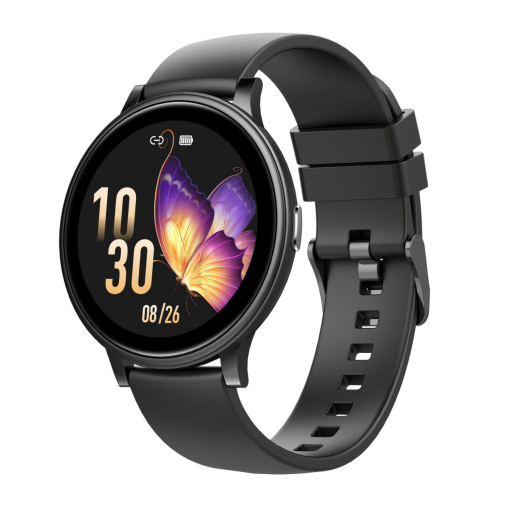
Midnight Black on the same case: the colourway that sells to the customer who wants the watch to disappear under a cuff.
The strap is 18 mm and silicone, matched to the case colour. At 18 mm the lug is a standard width, so the customer can fit a third-party strap, a retailer can refresh stock it already owns, and a second strap becomes an accessory line rather than a spare part. On a slim case the strap choice changes the character of the product more than the case does: a soft silicone strap keeps it casual, and a leather or mesh strap moves it toward smart-casual without touching the tooling.
Thickness is a claim that has to be measured rather than described. The specification sheet says 8.9 mm, and one marketing page quotes a larger figure that appears to include the sensor housing. Both can be true at different reference points, which is exactly why the measurement method belongs in the purchase order and a caliper belongs in the sample review.
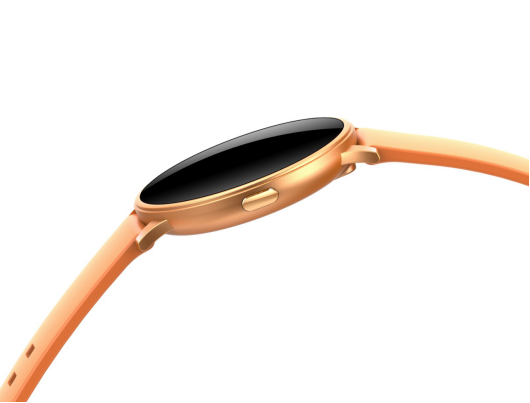
The case in profile at 8.9 mm, which is where the slim claim is either true or exposed.
2. A 1.26 inch IPS display with menus worth showing
The display is a 1.26 inch IPS TFT at 240 by 240, 189 PPI, 500 nits, with OGS touch. On a slim round case that is the right combination for the way the product is used: large numerals, a photographic dial, icons read at a glance. It is not a panel for reading long notifications, and the honest positioning is a watch that tells you what arrived rather than one you read email on.
Where this platform puts its design effort is the interface. Six menu layouts are selectable, including list, honeycomb, helm, ball and array, with list as the default, and eight transition styles run from scaling and horizontal sliding to several flip variants. Together with the watch-face market and the custom face builder, that gives a brand enough variation to lead a launch with three or four faces and two menu styles, which is what makes a value product look considered rather than generic.
Two technical details support that: the chipset carries a 2.5D GPU with multi-layer blending and JPEG decode, so composed dials animate without stutter, and the OGS touch layer removes the air gap, which keeps a 1.26 inch screen readable at an angle. On a sample, check two menu styles and two transitions, because the default view is the one that was polished hardest.
3. Calling, 123 sport modes and a week that fits a real routine
Calling is the feature that carries the price. Bluetooth 5.4 dual-mode with 13 dBm maximum transmit power lets the wearer answer and end calls from the wrist, with eight contacts stored on the watch, and the audio path is a 500 mW Class-D amplifier into 4 ohms with a 16-bit ADC at 98 dB signal-to-noise, supporting SBC, AAC, CVSD and mSBC. That is enough headroom to be intelligible in a quiet room and enough noise margin that the other party is not listening to a hiss.
Sports coverage is 123 modes with automatic recognition and track recording, plus step, calorie and distance counting. Daily tools run to weather, alarms, stopwatch and timer, flashlight, calculator, a voice assistant, breathing training, a world clock, a digital business card, a 2048 game, do-not-disturb and raise-to-wake, with music and camera control and a find-watch function completing the list. That breadth is what turns a calling watch into a daily carry rather than an accessory taken off at home.
Endurance is a 200 mAh cell rated at 0.814 Wh, giving 3 to 5 days of use and 12 to 18 days of standby, charged magnetically at DC 5V through a 300 mA controller. A wearer taking several short calls a day should plan on the 3 to 4 day end, which is still a routine of charging twice a week rather than nightly, and that is the practical promise to put on the box.
4. IP68 Waterproof with an acoustic case, and 13 languages
Water protection is the detail that separates a calling watch from a band: the case has a microphone port and a speaker chamber, so the sealing has to work around acoustic openings rather than around a solid shell. The MR525 is rated IP68 to 1.5 metres, which covers hand-washing, rain and a sweaty session, and does not cover swimming or a pressurised shower. The magnetic charging path helps here, because there is no exposed USB socket to leak.
Language support is 13 built-in watch languages: English, Chinese, Japanese, Korean, German, French, Spanish, Arabic, Russian, Portuguese, Indonesian, Thai and Vietnamese, with the Da Fit app covering the major global languages on both Android and iOS. Firmware updates are delivered over the air, so a face or a translation correction can be pushed after launch rather than handled as a service trip.
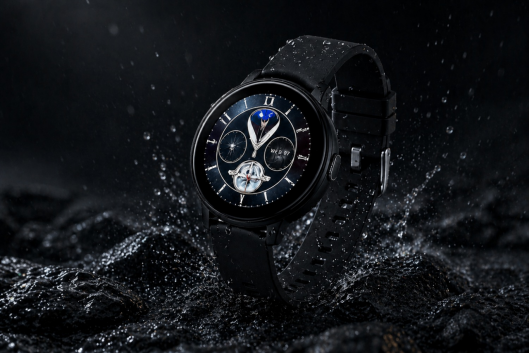
Water on an acoustic case is the test that matters: the microphone port and speaker chamber have to stay sealed, not just the glass.
5. Built for your brand
The MR525 is positioned for programmes that need a slim round calling watch at a defensible cost: 43 mm case at 8.9 mm, PC plus ABS moulding, 1.26 inch IPS display with six menu styles, Bluetooth 5.4 calling with eight stored contacts, IP68 to 1.5 metres, 123 sport modes and 3 to 5 days of use, packaged behind a Da Fit app that already speaks the major global languages.
Fixed: case dimensions and material, panel, chipset and audio path, sensors, cell and sealing design, so the water-resistance report and the certification file stay valid. Yours: case and strap colour, logo and placement, packaging, accessory set, pre-installed face list, default menu layout and app skin. Price, minimum quantity and lead time are quoted per project, because the colour mix, the packaging and the accessory set each move cost and schedule.
Send the target retail price, the quantity, the destination market, the colour mix and the certifications your market requires, and the answer will be whether this platform fits the price you have to hit. Then judge it on a wrist, with a call, in daylight, which is where this product either convinces a buyer or does not.
FAQ (Buyer's Quick Reference)
8.9 mm per the specification sheet, on a 43 mm round PC plus ABS case. One marketing page quotes a larger thickness that appears to include the sensor housing, so the reference point has to be agreed in writing and checked with a caliper on the approved sample. Both figures can be legitimate; only one belongs in your product copy.How thin is the case, really?
It is 240 by 240 at 189 PPI, with 500 nits and OGS touch, which is right for large numerals, photographic dials and glanceable icons, and not right for reading long messages. Compare resolution rather than the phrase high-definition, and check it outdoors in shade and in direct sun before you commit to a legibility claim.Is the 1.26 inch screen sharp enough?
It takes calls. Bluetooth 5.4 dual-mode with answer and end on the watch, eight stored contacts, a 500 mW Class-D amplifier and SBC, AAC, CVSD and mSBC codec support. Test intelligibility at arm's length in a noisy room and the delay after pressing answer, because that is what the customer will judge.Can it really take calls, or is it only a notification mirror?
No. The IP68 rating here means 1.5 metres of resistance covering hand-washing, rain and sweat, not swimming or a pressurised shower. The case has a microphone port and a speaker chamber, so the acoustic openings are the parts to inspect on a sample, along with the contacts and the magnetically charged back.Does IP68 Waterproof mean she can swim with it?
Continuous heart rate, sleep monitoring, stress tracking, menstrual cycle reminders, sedentary and hydration reminders. Present all of it as trends, not measurements: the sensor is an optical wrist module, not a medical instrument. The sheet also names the sensor two different ways, VC30F-SG in the highlights block and Vcare HX3602 in the hardware table, so confirm the string before printing it.What does 24/7 Health Monitoring include, and what should the copy avoid?
Quoted per project. The colour mix, the packaging, the accessory set and the pre-installed face list all move cost and schedule, and the packaging data is not published in the specification sheet, so freight has to be measured rather than estimated. Send target quantity, destination market, colour mix and the certifications your market requires, and the quotation will describe the configuration you can actually sell.What about price, MOQ and lead time?
Let's Discuss Your Project
If you are planning a slim round calling watch for the 2026 or 2027 season, five pieces of information make the conversation useful immediately: your target retail price, the quantity, the destination market, the colour mix you intend to lead with, and the certifications your market requires. With those we can say whether this 43 mm platform fits the price you have to hit, which colourways can be held stable across lots, and arrange samples in both colours so the fit and the finish can be judged on a wrist.
Tell us how your customers will wear it, at the office, at the gym, on the commute, and the specification stops being a table of numbers and becomes a programme you can defend on the shelf and in after-sales.
Contact us
Send your requirement through the contact details below, and include target quantity, destination market, the colour mix you plan to offer and the certification documents your market requires, so that the reply is a configuration and a quotation rather than a question.
Website: www.szmorrison.com
Email: sales06@szmorrison.com
WhatsApp: +86 17318011665

Quick Links
Contact us
Categories