
2.8 mm With a Display: How Buyers Should Specify an Ultra-Slim Screen Band for 2026 Programs
Introduction: Why This Question Matters to You
The display band is the most crowded shelf in wearables and the hardest to differentiate. Every supplier shows the same three icons, the same step count and the same promise of a long battery life; what separates one product from another is how much engineering was spent on the two numbers that a buyer cannot see in a photo, the thickness of the case and the efficiency of the electronics inside it. A band that is 2.8 mm thick with a working display, a heart-rate sensor and a five to seven day run-time is doing something structurally different from a 9 mm band with the same feature list, and that difference is what a distributor or a private-label brand is really buying.
This article is written for the buyer who has to translate a marketing claim into a purchase decision: which lines of a specification sheet decide the return rate, which FABE claims are worth paying for, where the cost sits, and how a sample becomes a repeat order. The B8 is used as the worked example throug hout, because its specification is unusually complete: a 46 by 19.5 by 2.8 mm device in zinc alloy and epoxy resin, an OM6626B platform on BLE 5.3, a 33 mAh cell rated for five to seven days, an HX3918 optical sensor for heart rate, blood oxygen, stress and HRV, sleep time and quality tracking, multiple sport modes, female cycle tracking, a shake-to-shoot camera trigger, and documented ESD, surge, drop and vibration standards.
Three things make this category worth the effort. The display is the only part the wearer looks at, so its legibility at arm's length decides perceived quality before any sensor does. The case is the only part other people see, which is why a metal finish on a thin body sells better than a plastic one at the same price. And the app is where the data actually lives, so the pairing experience, not the feature list, is what generates reviews.
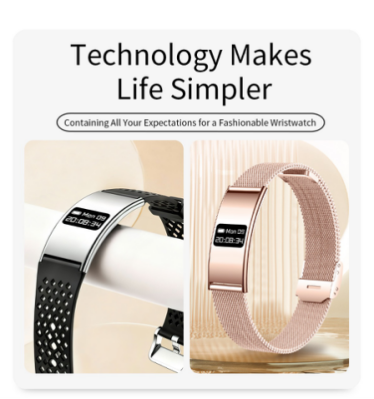
Two standard colourways: a black silicone strap and a rose-gold mesh strap on the same 2.8 mm case, with a display that stays legible at a glance.
Section 1: Key Concepts Every Buyer Should Understand
1. What 2.8 mm actually costs in engineering
A thin band is not a thin watch. Three subsystems compete for the same vertical space: the display module with its driver, the optical sensor stack, which needs a clear optical path to the skin, and the cell plus the charging coil. In a 9 mm case they can be stacked without thought. At 2.8 mm every layer has to be co-designed, which is why the numbers on the sheet come in a cluster: a 33 mAh cell rather than a 100 mAh one, a low-power chipset, and a display chosen for legibility per milliwatt rather than for resolution.
For a buyer this has a practical consequence. You cannot order a thin case and then ask for the battery life of a thick one. The claim of five to seven days of working time on 33 mAh is credible only because the rest of the platform is efficient: OM6626B on BLE 5.3, a sensor that samples rather than streams, and firmware that keeps the display dark until the wrist turns. Ask for those three together, and treat any quotation that offers a 2.8 mm case with a 200 mAh cell as a specification error rather than a bargain.
2. The display economy: what the screen must show, and what it must not attempt to do
On a band this thin the display is a notification surface, not a second phone. The functions that earn their place are the ones a wearer checks in under two seconds: time and date, an incoming call with the caller's name, a heart-rate reading during exercise, and confirmation that a measurement has started or finished. Everything else belongs in the app, because reading a paragraph on a band display is a design failure that shows up in reviews as a screen that is too small to use.
Two engineering details decide whether the display feels expensive or cheap, and neither appears in a feature list. The first is wake behaviour: the screen has to come on when the wrist turns without lighting up during sleep. The second is the finish over the glass. A zinc-alloy frame with an epoxy-resin body, as on the B8, gives the case a metal edge that reads as jewellery in daylight; a full plastic shell at the same thickness reads as a toy. That is the FABE advantage in this category: the thin body and the metal finish are the same argument, because each makes the other visible.
3. IP68 Waterproof on a 2.8 mm body: where the seal has to live
Water resistance is harder to achieve as the case gets thinner, because there is less depth for a gasket and less material around the joints. On a band with a display, the seal has to protect three interfaces at once: the display bond, the sensor window over the optical stack, and the charging path. An IP68 rating on a thin body therefore implies three specific design decisions: a display bonded rather than clamped, an optical window that is part of the sealed assembly, and a magnetic charging connection instead of an open socket.
For the buyer the rating converts directly into a marketing claim and a return-rate number. A band that survives hand-washing, rain, sweat and a shower is a band people leave on, and a band people leave on produces the continuous data that the health features depend on. A band that has to be removed for every sink visit produces gaps, and gaps are what generate one-star reviews about sleep data that does not match the night.
The test to demand is not a marketing phrase but a method: which standard, which depth, which duration, and whether the check is a hundred-percent end-of-line step or a sampling step. Sealing fails at assembly long before it fails at design, so the process control matters as much as the claim.
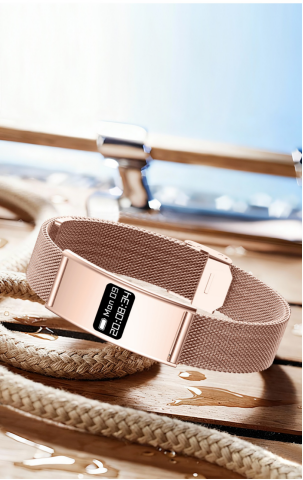
A rose-gold mesh band after water contact: the sealed case, the bonded display window and the closed charging path are what the rating actually describes.
4. 24/7 Health Monitoring when four signals share one optical platform
The B8 measures heart rate, blood oxygen, stress and heart rate variability from a single HX3918 optical sensor. That is a commercial advantage as much as a technical one: four indicators that a buyer can present as one dashboard, on one sensor cost, with one calibration routine. The alternative, a different sensor per metric, raises the bill of materials and multiplies the failure modes without improving what the user sees.
What matters in daily use is not the number of metrics but whether they move in a way the wearer can act on. Heart rate over a day shows the effect of a late meeting; HRV shows recovery; blood oxygen is read at rest and during sleep; stress load explains why a day that felt calm scored badly. Presented together, they answer the question a user actually asks, which is whether to train harder or rest. Presented separately, they are four numbers nobody returns to.
Sampling is the other half of continuous sensing. A band that measures continuously and reports in the app only after a sync is a band that gets removed; a band whose display confirms a reading on the wrist, and whose app keeps the trend, gets worn. That balance between on-wrist confirmation and in-app depth is what the two-part interface of a display band is for.
5. Sleep time versus sleep quality: the metric that decides retention
Sleep is the feature that keeps a band on the wrist at night, and it is the feature most often specified badly. Sleep detection as a line item can mean anything from a duration estimate to a staged analysis. The distinction that matters is between time in bed and quality: a seven-hour night with frequent wake events is not the same product experience as a seven-hour night with deep sleep through the middle, and only the second one can be presented as an improvement the user can act on.
A credible sleep specification therefore states both parts, time and quality, and shows how quality is derived. On the B8 the sleep report covers sleep time and sleep quality, and the app presents the night as a staged record with a summary score, which is the structure that makes the report readable in the morning rather than a chart the user has to interpret.
6. Sport modes, steps and the odd feature that sells the product
Step counting is the baseline every band has; what separates products is whether the activity record survives a week of mixed use. Multiple sport modes plus a daily step baseline, synchronised into one app record, let a buyer present the band to both audiences: the walker who wants 10,000 steps and the runner who wants a session log. The evidence line to check is the accelerometer part number, because a generic three-axis part is where step accuracy quietly degrades.
One feature deserves a paragraph of its own because it is disproportionately persuasive in retail: shake-to-shoot. Shaking the wrist triggers the phone camera shutter, which turns a band with no camera into a remote control for group photos and tripod shots. It costs almost nothing in hardware, it is demonstrable in ten seconds on a shop counter, and it gives the sales floor something to do with the product other than read the box. Buyers should treat features like this as merchandising, and specify that they are tested on both Android and iOS, because the camera trigger depends on app permissions that differ between platforms.
Section 2: How to Compare Suppliers, Criteria, Risk Points and a Checklist
Bands in this segment look alike in photos and diverge in the details that generate returns. The table below lists the lines that decide the outcome for a 2.8 mm display band, what a credible specification states for each, and the wording that should trigger a second question before you approve a sample.
Specification line | What a credible sheet states | Red flag in a supplier sheet |
Case build | 46 x 19.5 x 2.8 mm, zinc alloy plus epoxy resin, with the display bonded into the case. | Ultra-thin with no dimensions. |
Display behaviour | Wake on wrist turn, call name, time and date, live heart rate, dark during sleep. | Colour display with no stated functions. |
Platform | OM6626B with BLE 5.3, fixed part number for repeat orders. | Low-power chip with no part number. |
Cell and run-time | 33 mAh, about 5-7 days of working time, about 2 hours to full, charging input 1 A or less. | No capacity, or a 30-day claim from the same cell. |
Charging path | Magnetic cable with an SMT protection IC and a stated current limit. | Open charging port on a thin case. |
Sealing statement | Written IP68 rating plus the test method used per production lot. | Water droplets in a photo and no rating. |
Optical sensor | HX3918 heart-rate sensor feeding heart rate, blood oxygen, stress and HRV. | High-precision sensor, no part number. |
Health coverage | Heart rate, blood oxygen, stress, HRV, female cycle, sleep time and quality. | Heart rate and step count only. |
Sleep reporting | Both sleep time and sleep quality, presented as a staged night with a score. | Sleep monitoring as one line. |
Activity set | Established accelerometer (SC7A20H), multiple sport modes, step count, one synced record. | Mode count with no accelerometer part number. |
Camera trigger | Shake-to-shoot verified on Android and iOS with the permission flow documented. | Feature claimed without a platform test. |
App and OS floor | Nx Wear on Android 6.0 and above and iOS 11.0 and above, store or QR download. | App name changes per batch. |
Environmental spec | 0-45 C operating, -10-55 C storage, 5-95 percent non-condensing humidity. | Temperature range omitted. |
Reliability references | ESD contact plus or minus 6 kV and air 10 kV, surge 12 V, charging cut-off at 45 C, drop and vibration to GB/T 2423.8 and GB/T 2423.10. | No test standard named. |
Packing data | Gift box 270 x 71 x 21 mm, 100 pieces per carton at 540 x 380 x 235 mm. | No carton dimension or piece count. |
Six questions worth putting in the first email, before price:
· Thin-case evidence. Can you send a sample with a caliper measurement of the case, and confirm the alloy and epoxy layers in writing?
· Display functions. Which functions run on the display without the phone, and what happens to screen brightness when the wearer is asleep?
· Sealing method. Which standard is the water rating tested to, and is the check a hundred percent end-of-line step or a sampling step?
· Sensor parts. Which optical sensor and which accelerometer are fitted, and are those part numbers frozen across repeat orders?
· Sleep logic. How is sleep quality derived, and does the app report time and quality separately?
· Platform test records. Has the shake-to-shoot trigger been verified on both Android and iOS, and which permission flow is documented?
The pattern behind these questions is the same as in every wearable category: a thin display band is specified by the parts that are hardest to fake, the case, the sensor, the cell and the sealing method, rather than by the length of a feature list.
Section 3: From Sampling to Bulk Order, How It Usually Works
1. Sampling: what to test in the first ten days
A sample in this category should be tested on four things before price becomes a conversation. Wear it for a week and check that the run-time claim holds with the display in normal use, since display wake behaviour is the largest variable in real battery life. Wear it for three nights and read the sleep report on each, to see whether the quality score moves with what you actually experienced. Take a heart-rate reading against a chest strap or a reference device at rest and during exercise. And put it in a sink for ten minutes, because a thin case is exactly the case where sealing has the least margin.
Ask for the sample to be the production configuration: same display module, same strap, same firmware build number. A sample with a different build invalidates the test you just ran, and it is the most common reason a first shipment fails an incoming inspection that was designed around a hand sample.
2. Customisation and OEM/ODM: what can change and what should not
The sensible split on a platform like this is between the parts that carry your approvals and the parts that carry your brand. Case dimensions, display module, sensor set, cell, sealing method and firmware behaviour should stay fixed across lots, because they are what your test basis and your after-sales script rest on. Finish, strap material and colour, logo placement, packaging, accessory set, app skin and the default watch face are all fair game for an OEM program.
Two requests are worth raising at the sampling stage rather than later. A different strap changes how the band sits on the wrist, and a metal mesh strap holds the case at a slightly different angle from a silicone one, so the optical contact, and therefore the heart-rate trace, should be re-checked with the final strap. A different default watch face is trivial in software but affects the retail photo, so it belongs in the artwork review rather than after packaging is printed.
3. Bulk production: the parameters that move with volume
Volume changes three things in this category. Component allocation for the display module and the optical sensor has to be locked, because these are the parts substituted when demand spikes, and a substituted display module at 2.8 mm can force a case change. The firmware build has to be frozen with a version number, since battery life and sleep logic are judged on the build you approved. And the strap and finish combination has to be finalised per market, because a rose-gold mesh and a black silicone are different SKUs for a retailer even when the case is identical.
Everything else scales predictably: assembly, sealing test, display test, charge and run-time check, cosmetic inspection and packing at 100 pieces per carton. Ask for the sealing test and the display test to be hundred-percent steps at end of line, since both failures are invisible in a sealed carton and expensive at the returns desk.
4. Quality control and delivery: the five-line inspection
A practical incoming inspection for a thin display band has five lines: a caliper check on the case against the approved sample, since thickness is the product's core claim; a display check covering wake, call notification and low-light behaviour; a heart-rate and blood-oxygen comparison against a reference device; a full charge and run-time check against the approved sample; and a ten-minute water test on the sealed case. Keep the measurement record with the lot, because comparing a later shipment's caliper reading against the golden sample is the fastest way to catch a case change that was never disclosed.
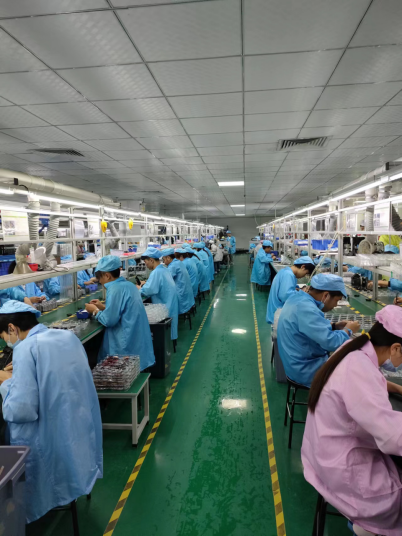
For delivery, the packing data should travel with the purchase order: gift box 270 by 71 by 21 mm, 100 pieces per carton at 540 by 380 by 235 mm, with the carton weight stated by the supplier rather than estimated by the buyer. On a thin product the risk in transit is not weight but compression, so ask whether the gift box has an inner support that keeps the case off the box wall.
Section 4: Introducing the B8 Ultra-Slim Display Health Band
1. A 2.8 mm zinc-alloy body that reads as jewellery
The B8 measures 46 by 19.5 by 2.8 mm and is built from zinc alloy with an epoxy resin body, which is the combination that produces a metal edge and a flat profile at the same time. On the wrist that translates into a band that sits under a shirt cuff without a bump and looks deliberate rather than accidental. Two standard colourways cover the retail spread: a black silicone strap for the sport and everyday end, and a rose-gold mesh strap for the gift and fashion end, both on the same case.
Front view: the display sits flush in the alloy frame, with the call notification and time readable at a glance.
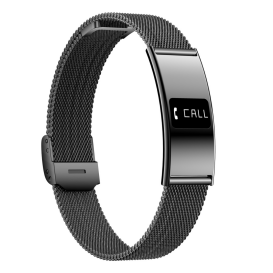
The same case from the strap side: a 2.8 mm profile, a metal mesh strap and a clasp that keeps the band flat on the wrist.
2. IP68 Waterproof, 5-7 days of run-time and a protected charging path
The B8 is sealed to IP68 on a case this thin, which is the claim that matters most in daily use: hand-washing, rain, sweat during a recorded workout and a shower at the end of the day are all within its intended use. The charging path is closed, a magnetic cable rather than an open socket, and the cable carries an SMT protection IC with the charging input limited to 1 A or less, so a mismatched adapter cannot push current the cell was not designed for.
Run-time is where the thin case pays for itself: a 33 mAh cell delivers about five to seven days of working time, with roughly two hours to a full charge, and charging temperature protection cuts in at 45 degrees Celsius. For a retail buyer that is the line that decides whether the product is bought again: a week between charges is a habit, and anything shorter is a chore.
3. 24/7 Health Monitoring from one optical platform
Heart rate, blood oxygen, stress and heart rate variability are measured through a single HX3918 optical sensor, with an SC7A20H accelerometer handling movement, steps and sleep staging. In the Nx Wear app the four signals sit in one view alongside sleep time and sleep quality, step count, multiple sport modes and a female physiological cycle record, which is what makes 24/7 Health Monitoring a reading the user can act on rather than four separate numbers.
Two smaller features make the package easier to sell on a counter. Shake-to-shoot turns the band into a remote shutter for the phone camera, useful for group photos and tripod shots when the phone is set up at a distance. And the display itself carries the fast checks, time, date, an incoming call with the caller's name and a heart-rate reading, so the wearer does not have to open the app to confirm that a measurement is happening.
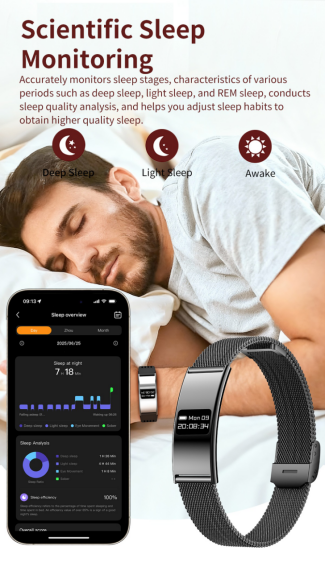
The sleep report in the app: staged night, sleep time and sleep quality in one view, with the display showing the time and the day's step count on the wrist.
4. Tested reliability, documented in standards rather than adjectives
Reliability on this platform is specified rather than asserted: operating temperature 0 to 45 degrees Celsius, storage -10 to 55, working humidity 5 to 95 percent non-condensing, electrostatic protection at plus or minus 6 kV contact and 10 kV air, surge protection at 12 V, charging temperature protection at 45 degrees, and drop and vibration tested by reference to GB/T 2423.8 and GB/T 2423.10. A distributor can quote those references to their own customers, which is worth more than a page of adjectives when a tender asks for test evidence.
Connectivity and compatibility are equally explicit: OM6626B on BLE 5.3, the Nx Wear app on Android 6.0 and above and iOS 11.0 and above, downloadable from either store or by scanning the QR code in the manual. The QR route matters in retail, because a printed code on the box removes the most common after-sales question in the first five minutes of ownership.
5. Built for your brand
B8 is positioned for private-label and OEM programs where a thin case, a metal finish and a documented test basis are the selling points: the display module, sensor set, cell and sealing method stay fixed so approvals and after-sales scripts remain valid, while strap material, finish, logo, packaging, accessory set and default watch face are matched to your market.
If your roadmap needs a different strap, a bundled second strap or a different retail box, that conversation belongs at the sampling stage. A strap change affects the optical contact and therefore the heart-rate trace, and a box change affects how the case survives compression in transit; both are cheaper to settle before the golden sample is signed than after packaging artwork is on press.
FAQ (Buyer's Quick Reference)
The device measures 46 by 19.5 by 2.8 mm in zinc alloy with an epoxy resin body. The display is a notification surface rather than a small phone: it carries time and date, an incoming call with the caller's name and a live heart-rate reading, wakes on a wrist turn, and stays dark during sleep so it does not disturb the wearer.How thin is the B8, and does the display still work properly?
It is rated IP68 Waterproof, with the display bonded into the case and charging handled by a magnetic cable instead of an open socket, so hand-washing, rain, sweat and a normal shower are within its intended use. Ask for the per-lot sealing test record before you commit to a production run, because sealing fails at assembly before it fails at design.Can the band be worn in the shower?
About five to seven days of working time, with roughly two hours to a full charge on a magnetic cable carrying an SMT protection IC and a charging input limited to 1 A or less. Charging temperature protection cuts in at 45 degrees Celsius. Display wake behaviour is the largest variable in real-world battery life, which is why the run-time claim is tested with the display in normal use rather than with it switched off.How long does the battery last on a 33 mAh cell?
Heart rate, blood oxygen, stress, heart rate variability, sleep time and sleep quality, step count, multiple sport modes and a female physiological cycle record, all through an HX3918 optical sensor and an SC7A20H accelerometer, presented in the Nx Wear app on Android 6.0 and above and iOS 11.0 and above.What does it measure, and where do the results appear?
Sleep time is how long the wearer was asleep; sleep quality is derived from the staged night and reported as a score in the app. Both are shown separately, because a long night with frequent wake events and a shorter night of deep sleep are different results and should not collapse into one number.What is the difference between sleep time and sleep quality?
These are quoted per project, because strap material, finish, packaging, accessory set and app skin all move both cost and schedule. Send target quantity, destination market and the colourway or strap you plan to offer, and we will quote against that configuration rather than against a generic price list.What about price, MOQ and lead time?
Let's Discuss Your Project
If you are planning a thin display band for a 2026 or 2027 programme, the fastest route to a useful answer is to send five things: your target retail price, estimated quantity, destination market, the strap and colourway you intend to lead with, and the packaging set you plan to offer. With those we can tell you which build fits the price you have to hit, which lines can be held stable across lots, and arrange a sample you can test against the thickness, run-time and sealing claims on this page.
Tell us how your customers will actually wear it, under a shirt cuff, in the gym, in the shower, at night, and the specification stops being a table of numbers and becomes a programme you can defend on the shelf and in after-sales.
Contact us
Send your requirement to the contact below, and please include target quantity, destination market, preferred strap and colourway, and the packaging set you plan to offer so we can reply with the right configuration and a quotation on the same page.
Website: www.szmorrison.com
Email: sales06@szmorrison.com
WhatsApp: +86 17318011665

Quick Links
Contact us
Categories